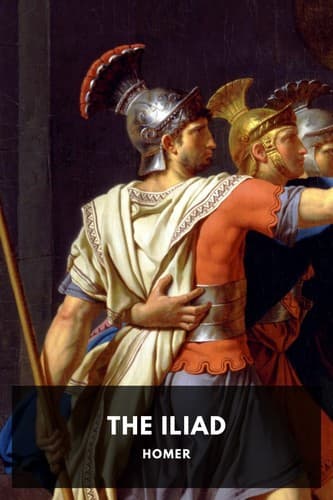
Achilles (Mythological character); Classical literature; Epic poetry, Greek -- Translations into English; Trojan War
She caught both Diana’s wrists with her left hand as she spoke,
and with her right she took the bow from her shoulders, and
laughed as she beat her with it about the ears while Diana
wriggled and writhed under her blows. Her swift arrows were shed
upon the ground, and she fled weeping from under Juno’s hand as a
dove that flies before a falcon to the cleft of some hollow rock,
when it is her good fortune to escape. Even so did she fly
weeping away, leaving her bow and arrows behind her.
Then the slayer of Argus, guide and guardian, said to Leto,
“Leto, I shall not fight you; it is ill to come to blows with any
of Jove’s wives. Therefore boast as you will among the immortals
that you worsted me in fair fight.”
Leto then gathered up Diana’s bow and arrows that had fallen
about amid the whirling dust, and when she had got them she made
all haste after her daughter. Diana had now reached Jove’s
bronze-floored mansion on Olympus, and sat herself down with many
tears on the knees of her father, while her ambrosial raiment was
quivering all about her. The son of Saturn drew her towards him,
and laughing pleasantly the while began to question her saying,
“Which of the heavenly beings, my dear child, has been treating
you in this cruel manner, as though you had been misconducting
yourself in the face of everybody?” and the fair-crowned goddess
of the chase answered, “It was your wife Juno, father, who has
been beating me; it is always her doing when there is any
quarrelling among the immortals.”
Thus did they converse, and meanwhile Phoebus Apollo entered the
strong city of Ilius, for he was uneasy lest the wall should not
hold out and the Danaans should take the city then and there,
before its hour had come; but the rest of the ever-living gods
went back, some angry and some triumphant to Olympus, where they
took their seats beside Jove lord of the storm-cloud, while
Achilles still kept on dealing out death alike on the Trojans and
on their horses. As when the smoke from some burning city ascends
to heaven when the anger of the gods has kindled it—there is then
toil for all, and sorrow for not a few—even so did Achilles bring
toil and sorrow on the Trojans.
Public-domain text, read in full here on John Shaqi.
Reviews
Reviews
No reviews yet
Be the first to share your thoughts on this work.
Elsewhere in the archive
Join the Discussion
Join the discussion
Sign in to leave a comment or review.
Sign InorCreate an account