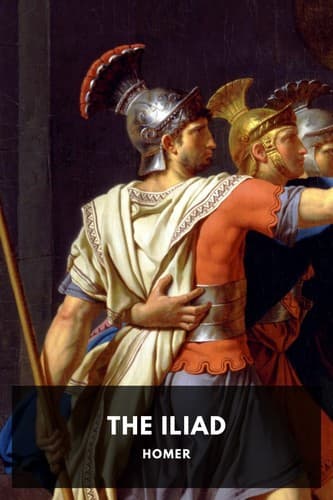
Achilles (Mythological character); Epic poetry, Greek -- Translations into English; Trojan War
“Hear me, ye Trojans, and Dardanians, and allies, that I may tell you
what the soul in my breast commands. Now take repast through the army,
as heretofore, and be attentive to the watch, and let each be mindful
of guard. But in the morning let Idæus proceed to the hollow ships, to
announce to the sons of Atreus, Agamemnon and Menelaus, the resolution
of Alexander, on whose account the contention has arisen; and let him
add this prudent request also, whether they wish to desist from
horrid-sounding war, until we burn the dead; afterwards will we fight
again till fate separate us, and give the victory to one or other of
us.”
Thus he said: but they heard him very attentively, and obeyed. Then
they took their repast throughout the city, by companies. In the
morning Idæus went to the hollow ships. He found the Greeks, the
servants of Mars, in council, at the stern of 262 Agamemnon’s ship: and
the clear-voiced herald, standing in the midst of them, spoke thus:
“Ye sons of Atreus, and ye other chiefs of all the Greeks, Priam and
the other illustrious Trojans command me to tell you, if it be
agreeable and pleasing to you, the determination of Alexander, on whose
account this contention has arisen.”
Footnote 262: (return) Dative for genitive, by the Schema Colophonium.
See Lesbonax, p. 181, ed. Valck.
“Whatever treasures Alexander brought in the hollow ships to Troy,
(would that he first had perished,) all these is he willing to give up,
and even to add others from his own home: but he says that he will not
restore the wedded spouse of glorious Menelaus: certainly the Trojans,
at least, advise him. They also order me to make this proposal, to wit,
whether ye are willing to desist from dreadful-sounding war, until we
shall burn the dead: afterwards we shall fight again, till fate
separate us, and give the victory to one of us.”
Thus he said, but they all became mute in silence. At length Diomede,
brave in the din of war, spoke thus amongst them:
“Let none now receive the treasures of Alexander, nor Helen: for it is
plain, even [to him] who is a mere infant, that the issues of
destruction impend over the Trojans.”
Thus he said, and all the sons of the Greeks shouted, admiring the
words of horse-breaking Diomede: and then Agamemnon, king of men, thus
addressed Idæus:
“Idæus, thou thyself hearest, indeed, the sentiments of the Greeks, how
they answer thee; and such also pleases me. But concerning the dead, I
grudge not that [you] should burn them; for there is no grudge towards
the dead bodies, when they are dead, hastily to perform their obsequies
with fire: 263 but let loud-resounding Jove, the husband of Juno, be
witness of the treaties.”
Footnote 263: (return) Literally, “to appease [the dead].”
Public-domain text, read in full here on John Shaqi.
Reviews
Reviews
No reviews yet
Be the first to share your thoughts on this work.
Elsewhere in the archive
Join the Discussion
Join the discussion
Sign in to leave a comment or review.
Sign InorCreate an account