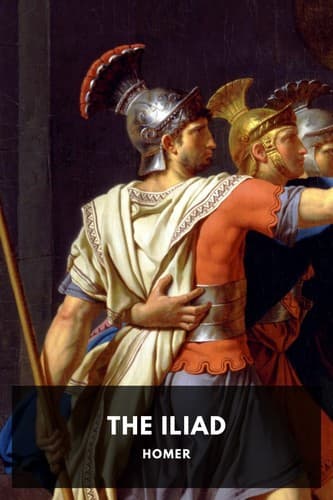
Achilles (Mythological character); Epic poetry, Greek -- Translations into English; Trojan War
Thus speaking, he despatched them, having added 42 a harsh command. But
they reluctantly went along the shore of the barren sea, and came to
the tents and ships of the Myrmidons. And they found him sitting at his
tent and his black ship: nor did Achilles, seeing them, rejoice. But
they, confused, and reverencing the king, stood still, nor addressed
him at all, nor spoke [their bidding]. But he perceived [it] in his
mind, and said:
“Hail, heralds, messengers of Jove, 43 and also of men, come near, for
ye are not blamable to me in the least, but Agamemnon, who has sent you
on account of the maid Brisëis. However, come, noble Patroclus, lead
forth the maid, and give her to them to conduct; but let these be
witnesses [of the insult offered me], both before the blessed gods, and
before mortal men, and before the merciless king. But if ever again
there shall be need of me to avert unseemly destruction from the rest,
[appeal to me shall be in vain], 44 for surely he rages with an
infatuated mind, nor knows at all how to view the future and the past,
in order that the Greeks may fight in safety at their ships.”
Thus he spoke. And Patroclus obeyed his dear companion, and led forth
fair-cheeked Brisëis from the tent, and gave her to them to conduct;
and they returned along by the ships of the Greeks. But the woman went
with them reluctantly, whilst Achilles, weeping, 45 immediately sat
down, removed apart from his companions, upon the shore of the hoary
sea, gazing on the darkling main; and much he be sought his dear
mother, stretching forth his hands:
Footnote 41: (return) Hesych. ρίγιον, φοβερώτερον, χαλεπώτερον.
Footnote 42: (return) “Misit eos, minaci jusso dato.”—Heyne.
Footnote 43: (return) So called from their inviolability,—άσνλον γαρ
και θείον το γένος των κηρύκων.—Schol. Και εζήν αντοίς πανταχόσε άδεώς
ίεναι.—Pollux, viii. They were properly sacred to Mercury (id. iv. 9.
Cf. Feith, Antiq. Homer, iv. 1), but are called the messengers of Jove,
as being under his special protection, with a reference to the
supporting of regal authority.
Footnote 44: (return) Observe the aposiopesis.
Footnote 45: (return) Not for the loss of Briseïs, but on account of
the affront.
“O mother, since thou hast borne me, to be but short-lived, at least
then ought high-thundering Olympian Jove to have vouchsafed honour to
me; but now he has not honoured me ever so little; for the son of
Atreus, wide-ruling Agamemnon, has dishonoured me; for he, taking away
my prize, possesses it, himself having wrested it [from me].”
Thus he spoke, weeping. But to him his venerable mother hearkened,
sitting in the depths of the ocean beside her aged sire. And
immediately she rose up from the hoary deep, like a mist. And then she
sat before him weeping, and soothed him with her hand, and addressed
him, and spoke aloud:
“Son, why weepest thou—on account of what has grief come upon thy mind?
Declare it, nor hide it in thy soul, that we both may know it.”
Public-domain text, read in full here on John Shaqi.
Reviews
Reviews
No reviews yet
Be the first to share your thoughts on this work.
Join the Discussion
Join the discussion
Sign in to leave a comment or review.
Sign InorCreate an account