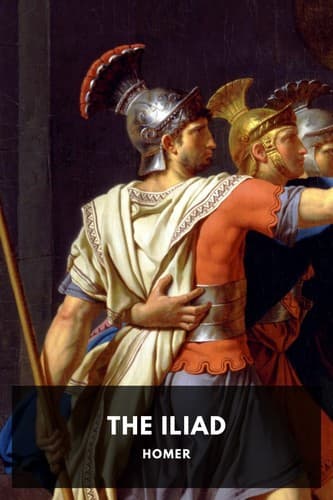
Achilles (Mythological character); Epic poetry, Greek -- Translations into English; Trojan War
“Hear me, ye Trojans, and Dardanians, and allies: I lately thought that
having destroyed the ships and all the Greeks, I should return back to
wind-swept Ilium. But darkness has come on first, which has now been
the chief means of preserving the Greeks and their ships on the shore
of the sea. But, however, let us now obey dark night, and make ready
our repasts; and do ye loose from your chariots your beautiful-maned
steeds, and set fodder before them: and quickly bring from the city
oxen and fat sheep; bring sweet wine and bread from your homes; and
besides collect many fagots, that all night till Aurora, mother of
dawn, we may kindle many fires, and the splendour may ascend to heaven:
lest haply in the night the long-haired Greeks attempt to fly over the
broad ridge of the ocean. That they may not at all events without toil
and without harm ascend their ships: but [let us] take care that each
of them may have to heal a wound 287 at home, being stricken either
with an arrow, or with a sharp spear, bounding into his ship; that
every other too may dread to wage tearful war against the
horse-breaking Trojans. Let the heralds, dear to Jove, proclaim through
the city, that the youths at the age of puberty, and the hoary-templed
sages, keep watch around the city, in the god-built turrets; and let
the females also, the feebler sex, in their halls each kindle a mighty
fire: and let there be some strong guard, lest a secret band enter the
city, the people being absent. Thus let it be, magnanimous Trojans, as
I say: and let the speech, which is now most salutary, be thus spoken.
But for that which will be [most expedient] in the morning, I will
[then] speak amongst the horse-breaking Trojans. Making vows both to
Jove and to the other gods, I hope to banish hence those dogs borne
hither by the fates, whom the fates bear in their black ships. 288 But
let us keep watch during the night, and in the morning, at dawn,
equipped with arms, let us stir up sharp conflict at the hollow ships.
I will see whether valiant Diomede, the son of Tydeus, will force me
back from the ships to our walls, or whether I shall bear away his
bloody spoils, having slain him with my brazen spear. To-morrow shall
he make manifest his valour, if he shall withstand my assaulting spear.
But I think that he will lie wounded amongst the first at sunrise
to-morrow, and many companions around him. Would that I were so
certainly immortal, and free from old age all my days, and honoured, as
Minerva and Apollo are honoured, as [I am certain] that this day will
bring evil upon the Greeks.”
Footnote 287: (return) Literally, “digest a weapon,” _i.e._ have a
wound to attend to. So _telum_ and _vulnus_ are used for each other in
Latin.
Footnote 288: (return) Surely this line is a gloss upon
κηρεσσιφορητους.
Public-domain text, read in full here on John Shaqi.
Reviews
Reviews
No reviews yet
Be the first to share your thoughts on this work.
Elsewhere in the archive
Join the Discussion
Join the discussion
Sign in to leave a comment or review.
Sign InorCreate an account