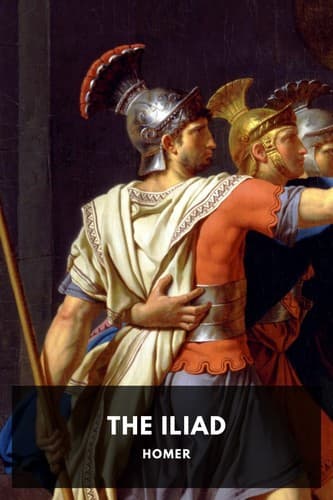
Achilles (Mythological character); Epic poetry, Greek -- Translations into English; Trojan War
Thus he spoke; and Patroclus obeyed his dear companion. But he
[Achilles] placed in the flame of the fire a large dressing-block, and
upon it he laid the chine of a sheep and of a fat goat, with the back
of a fatted sow, abounding in fat. Automedon then held them for him,
and noble Achilles cut them up; and divided them skilfully into small
pieces, and transfixed them with spits; whilst the son of Menœtius, a
godlike hero, kindled a large fire. But when the fire had burned away,
and the flame grew languid, strewing the embers, he extended the spits
over them, and sprinkled them with sacred salt, raising them up from
the racks. But when he had dressed them, and had thrown them upon
kitchen tables, Patroclus, taking bread, served it out upon the board
in beautiful baskets: but Achilles distributed the flesh. But he
himself sat opposite to noble Ulysses, against the other wall, and
ordered Patroclus, his companion, to sacrifice to the gods; and he
accordingly cast the first morsels 300 into the fire. And they
stretched forth their hands to the prepared viands which lay before
them. But when they had dismissed the desire of eating and drinking,
Ajax nodded to Phoenix, but noble Ulysses observed it, and having
filled his goblet with wine, he pledged Achilles:
Footnote 300: (return) Hesych. and Phrynicus (for their glosses should
probably be joined), θνηλάς’ άπαρχάς των τεθυμἑνων.
“Health, Achilles. We are not wanting of a complete feast, either in
the tent of Agamemnon, son of Atreus, or even here also, for many
strength-recruiting dainties are here; but the business of an agreeable
feast is not our care. We, O thou Jove-nurtured one, contemplating it,
rather dread a very great disaster, as it is matter of doubt whether
the well-benched ships be saved or destroyed, unless thou puttest on
thy might. For near the ships and the wall the high-minded Trojans and
their far-summoned allies have pitched their camp, kindling many fires
throughout the host; and they say that they will no longer restrain
themselves, but that they will fall upon our black vessels. 301 And
Saturnian Jove exhibiting to them propitious signs, darts his
lightning; and Hector, looking fiercely round in valour, rages
terribly, trusting in Jove, nor reverences at all either men or gods,
but great madness hath come upon him. He prays that divine morn may
speedily come. For he declares that he will cut off the poop-ends 302
of the ships, and burn [the ships] themselves with ravaging fire, and
slaughter the Greeks beside them, discomforted by the smoke. Wherefore
do I greatly fear in my mind lest the gods may fulfil his threats, and
it be destined for us to perish in Troy, far from steed-nourishing
Argos. Rise then, if thou hast the intention, although late, to defend
the harassed sons of the Greeks from the violent onslaught of the
Trojans. To thyself it will hereafter be a cause of sorrow, nor is it
possible in any manner to discover a remedy for a disaster when
Public-domain text, read in full here on John Shaqi.
Reviews
Reviews
No reviews yet
Be the first to share your thoughts on this work.
Elsewhere in the archive
Join the Discussion
Join the discussion
Sign in to leave a comment or review.
Sign InorCreate an account