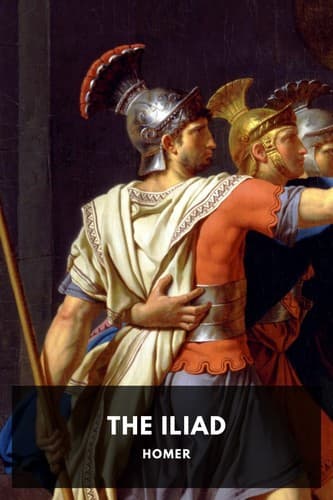
Achilles (Mythological character); Epic poetry, Greek -- Translations into English; Trojan War
“Hark! Diomede, a man comes from the camp; I know not whether as a spy
upon our vessels, or to plunder some of the dead bodies. But let us
suffer him first to pass by a little through the plain, and afterwards,
hastily rushing upon him, let us take him. If, however, he surpasses us
in speed, attacking him with the spear, let us continually drive him
from the camp towards the ships, lest by chance he escape towards the
city.”
Then having thus spoken, they lay down out of the pathway among the
dead; but he, in thoughtlessness, ran hastily past. But when now he was
as far off as is the space ploughed at one effort 352 by mules (for
they are preferable to oxen in drawing the well-made plough through the
deep fallow), they indeed ran towards him; but he stood still, hearing
a noise; for he hoped within his mind that his companions had come from
the Trojans to turn him back, Hector having ordered. But when now they
were distant a spear’s cast, or even less, he perceived that they were
enemies, and moved his active knees to fly; and they immediately
hastened to follow. As when two rough-toothed hounds, skilled in the
chase, ever incessantly pursue through the woody ground either a fawn
or hare, whilst screaming it flies before; thus did Tydides and
Ulysses, sacker of cities, pursue him ever steadily, having cut him off
from his own people. But when now flying towards the ships, he would
speedily have mingled with the watch, then indeed Minerva infused
strength into Tydides, that none of the brazen-mailed Greeks might be
beforehand in boasting that he had wounded him, but he himself come
second; then gallant Diomede, rushing on him with his spear, addressed
him:
“Either stop, or I will overtake thee with my spear; nor do I think
that thou wilt long escape certain destruction from my hand.”
Footnote 352: (return) See the Scholiast, and Kennedy’s note.
He said, and hurled his spear, but intentionally missed the man. Over
the right shoulder the point of the well-polished spear stuck in the
ground. Then indeed he stood still, and trembled, stammering (and there
arose a chattering of the teeth in his mouth), pale through fear.
Panting they overtook him, and seized his hands; but he weeping, spoke
thus:
“Take me alive, and I will ransom myself; for within [my house] I have
brass, and gold, and well-wrought iron; from which my father will
bestow upon you countless ransoms, if he shall hear that I am alive at
the ships of the Greeks.”
But him much-planning Ulysses answering addressed: “Take courage, nor
suffer death at all to enter thy mind; but come, tell me this, and
state it correctly: Why comest thou thus alone from the camp towards
the fleet, through the gloomy night, when other mortals sleep? Whether
that thou mightst plunder any of the dead bodies, or did Hector send
thee forth to reconnoitre everything at the hollow ships? Or did thy
mind urge thee on?”
Public-domain text, read in full here on John Shaqi.
Reviews
Reviews
No reviews yet
Be the first to share your thoughts on this work.
Elsewhere in the archive
Join the Discussion
Join the discussion
Sign in to leave a comment or review.
Sign InorCreate an account