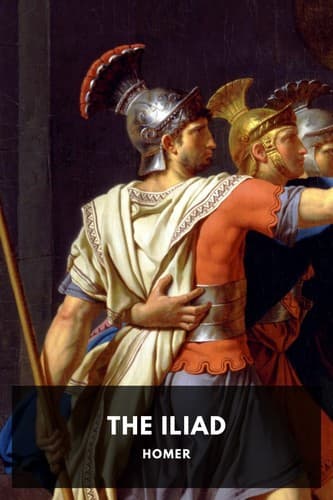
Achilles (Mythological character); Epic poetry, Greek -- Translations into English; Trojan War
Who knows if, advising him, thou mayest, with the gods’
assistance, arouse his mind? For the admonition of a friend is good.
But if within his mind he avoid some prophecy, and his venerable mother
has told him anything from Jove, let him at least send thee forth; and
with thee let the other forces of the Myrmidons follow, if indeed thou
mayest be some aid to the Greeks. Let him likewise give his beautiful
armour to thee, to be borne into battle, if perchance the Trojans,
assimilating thee to him, may abstain from the conflict, and the
warlike sons of the Greeks, already afflicted, may respire; and there
be a little respite from fighting. 388 But you, [who are] fresh, will,
with fighting, easily drive back men wearied, towards the city, from
the ships and tents.”
Footnote 384: (return) Cf iv. 540, for the distinction between
βεϑλημένοι and οὐτάμενοι.
Footnote 385: (return) _I. e._ the reputed sons.
Footnote 386: (return) See Schol. Etym. M. s.v., and Alberti on
Hesych. t, ii. p. 1247
Footnote 387: (return) Properly, the fence or barrier of the
enclosure.
Footnote 388: (return) There are several different interpretations for
this line: 1. Schneider explains it: “They have but short time to
respire; for if not at once assisted, they will be destroyed.” 2.
“Short will be the cessation from war.” 3. “A cessation, or
breathing-time, from war, although short, will be agreeable.” 4.
“Supply ‘_may be_’, and translate, ‘and that there _may be_ a short
breathing-time from the battle;’ although this last involves some
tautology with the preceding line.”—Ed. Dubl.
Thus he spake, and he aroused the spirit within his breast; and he
hastened to run to the ships to Achilles, the grandson of Æacus. But
when now Patroclus, running, arrived at the ships of godlike Ulysses,
where were their forum and seat of justice, and there the altars of
their gods also were erected, there Eurypylus, the noble son of Evæmon,
wounded with an arrow in the thigh, limping from the battle, met him.
Down his back ran the copious sweat from his shoulders and head, and
from the grievous wound oozed the black blood; nevertheless his mind
was firm. Seeing him, the gallant son of Menœtius pitied him, and,
grieving, spoke winged words:
“Alas! unhappy men, leaders and rulers over the Greeks, are ye then
thus destined, far away from your friends and native land, to satiate
the swift dogs at Troy with your white fat? But come, tell me this, O
Jove-nurtured hero, Eurypylus, will the Greeks still at all sustain
mighty Hector, or will they now be destroyed, subdued by his spear?”
Public-domain text, read in full here on John Shaqi.
Reviews
Reviews
No reviews yet
Be the first to share your thoughts on this work.
Elsewhere in the archive
Join the Discussion
Join the discussion
Sign in to leave a comment or review.
Sign InorCreate an account