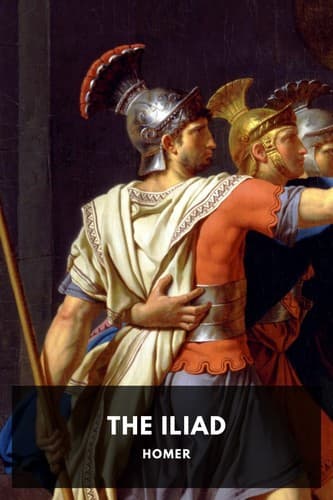
Achilles (Mythological character); Epic poetry, Greek -- Translations into English; Trojan War
But him then answered Agamemnon, king of men. “Nestor, since they are
combating at the sterns of the ships, and the constructed rampart
avails not, nor the ditch, at which the Greeks suffered much, and hoped
in their minds that it would be an impregnable defence to the ships and
to themselves, surely it will be agreeable to all-powerful Jove that
the Greeks perish here, inglorious, far away from Argos. For I was
conscious when he willingly gave assistance to the Greeks, and I now
know that he honours those [the Trojans] equally with the happy gods,
but hath fettered our courage and our hands. But come, let us all obey
as I shall advise. Let us draw down the ships, as many as are drawn up
first near the sea, and launch them all into the vast ocean. Let us
moor them at anchor in the deep, till mortal-deceiving 455 night
arrive, if even then the Trojans may abstain from battle, and then we
may perhaps draw down all the vessels; for there is no disgrace in
flying from evil, not even during the night. It is better for a flying
man to escape from evil, than to be taken.”
Footnote 455: (return) ‘Αβρότη is akin to ἤμβροτον from άμαρτάνω, and
therefore = “making mortals go astray,” or else = άμβροσιη in ii. 57.
See Buttm. Lexil. p. 82. Or it may be regarded as the “nox intempesta,”
_i.e._ “muita nox, qua nihil agi tempestivum est,” Censorinus de Die
Nat. xxiv.
But him sternly regarding, wise Ulysses then addressed: “Son of Atreus,
what speech hath escaped thy lips? Lost man! thou shouldst command some
worthless army, and not rule over us, to whom Jove hath granted, from
youth even unto old age, to accomplish toilsome wars, until we, each of
us, shall perish. Dost thou then desire thus to leave wide-wayed Troy,
on account of which we have endured so many woes? Be silent, lest some
other of the Greeks hear a speech, which a man ought not to have
brought through his mouth, whoever understands in his mind how to speak
prudent things, who is a sceptre-bearer, and whom so many people obey,
as many as thou dost govern among the Greeks. For now do I reprobate
thy judgment, in what thou hast said; who commandest us, whilst the war
and battle are waged, to draw down the well-benched ships to the sea,
in order that the wishes of the Trojans may be still better fulfilled,
victorious though they be, and dire destruction fall upon us: for the
Greeks will not maintain the fight whilst the ships are being dragged
to the sea, but will look back, and retire from the combat. Then will
thy counsel be injurious, O leader of the people.”
But him Agamemnon, the king of men, then answered: “Much, O Ulysses,
hast thou touched me to the soul with thy severe reproof; yet I
commanded not the sons of the Greeks against their will to draw the
well-benched ships down to the sea. But now would that there were one,
either young or old, who would deliver an opinion better than this; it
would be to my joy.” 456
Public-domain text, read in full here on John Shaqi.
Reviews
Reviews
No reviews yet
Be the first to share your thoughts on this work.
Elsewhere in the archive
Join the Discussion
Join the discussion
Sign in to leave a comment or review.
Sign InorCreate an account