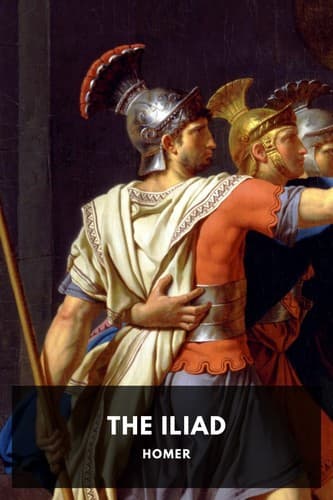
Achilles (Mythological character); Epic poetry, Greek -- Translations into English; Trojan War
But among them Diomede, valiant in the din of battle, also spoke: “The
man is near, we need not seek far, if indeed ye are willing to be
persuaded; and do not find fault each through wrath, because I am by
birth the youngest amongst you; for I boast that my race is from a
noble sire, Tydeus, whom the heaped-up earth 457 covers at Thebes. For
to Portheus were born three distinguished sons, and they dwelt in
Pleuron and lofty Calydon: Agrius and Melas, but the third was the
knight Œneus, the father of my father, who was conspicuous among them
for valour. He indeed remained there, but my father, as an exile, dwelt
at Argos, for so Jove willed and the other gods. But he married [one]
of the daughters 458 of Adrastus, and he inhabited a mansion opulent in
resources, and corn-bearing fields were his in abundance, and there
were many rows 459 of plants around him. Numerous were his herds, and
he surpassed the Greeks in the use of the spear; but these things ye
ought to know, since it is a truth. Do not, therefore, dispute the
opinion freely delivered, which I give advisedly, deeming that I am
base by birth, and unwarlike. Come, then, let us go to battle, wounded
as we are, from necessity. There, then, let us ourselves approach the
combat, out [of the reach] of weapons, lest any one receive wound upon
wound; and, encouraging others, we will urge them on, who hitherto,
gratifying their souls, have stood apart, nor fought.”
Footnote 456: (return) For this use of the dative, cf. Plato Phædon, §
24. So Tacit. Agric. “Quibus bellum volentibus erat.”—Kennedy. Cf.
Æsch. Prom. s.i., ἀσμένῳ δέ σοι Ἡ ποικιλείμων νῦζ ἀποκρύψει φάος.
Footnote 457: (return) See my note on Od. ii. p. 21, n. 35, ed. Bohn,
and an admirable dissertation on these classic barrow-tombs in
Stephen’s notes on Saxo-Grammaticus, pp. 90-92.
Footnote 458: (return) Deipyle. See Scholiast.
Footnote 459: (return) Not “gardens.” Schol. Theocrit. i. 48. Ὄρχατον
τὴν ἐπιστιχον φυτείαν ... καὶ Αριστοφάνης τὸ μεταξὺ τῶν φυτῶν
μετόρχμιον ἐκάλεσεν ἐν τοῖς γεωργοῖς’ καὶ Ἡσίοδος ὄρχον λέγει τὴν
ἐπιστιχον τῶν ἀμπέλων φυτείαν. Cf. Schol. on Lycophr. 857; Hesych. t.
ii. p. 792.
Thus he spoke; and to him they all listened readily, and obeyed.
Wherefore they hastened to advance, and the king of men, Agamemnon, led
them.
Nor did the illustrious Earth-shaker keep a negligent look-out, but he
went amongst them like unto an aged man, and he caught the right hand
of Agamemnon, the son of Atreus, and addressing him, spoke winged
words:
Public-domain text, read in full here on John Shaqi.
Reviews
Reviews
No reviews yet
Be the first to share your thoughts on this work.
Elsewhere in the archive
Join the Discussion
Join the discussion
Sign in to leave a comment or review.
Sign InorCreate an account