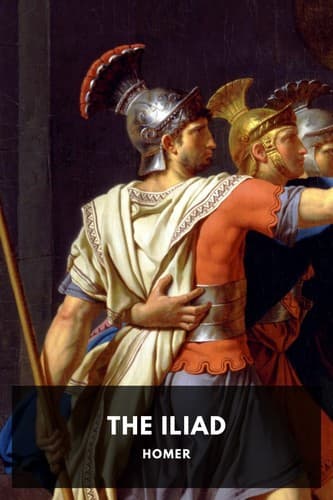
Achilles (Mythological character); Epic poetry, Greek -- Translations into English; Trojan War
“O friends, Grecian heroes, servants of Mars, Jove, the son of Saturn,
has entangled me in a heavy misfortune. Cruel, who before indeed
promised to me, and vouchsafed by his nod, that I should return home,
having destroyed well-fortified Ilium. But now he has devised an evil
deception, and commands me to return to Argos, inglorious, after I have
lost many of my people. So forsooth it appears to be agreeable to
all-powerful Jove, who has already overthrown the citadels of many
cities, yea, and will even yet overthrow them, for transcendent is his
power. For this were disgraceful even for posterity to hear, that so
brave and so numerous a people of the Greeks warred an ineffectual war,
and fought with fewer men; but as yet no end has appeared. For if we,
Greeks and Trojans, having struck a faithful league, 85 wished that
both should be numbered, and [wished] to select the Trojans, on the one
hand, as many as are townsmen; and if we Greeks, on the other hand,
were to be divided into decades, and to choose a single man of the
Trojans to pour out wine [for each decade], many decades would be
without a cupbearer. 86 So much more numerous, I say, the sons of the
Greeks are than the Trojans who dwell in the city. But there are
spear-wielding auxiliaries from many cities, who greatly stand in my
way, and do not permit me wishing to destroy the well-inhabited city.
Already have nine years of mighty Jove passed away, and now the timbers
of our ships have rotted, and the ropes have become untwisted. 87 Our
wives and infant children sit in our dwellings expecting us; but to us
the work for which we came hither remains unaccomplished, contrary to
expectation. But come, as I shall recommend, let us all obey; let us
fly with the ships to our dear native land, for at no future time shall
we take wide-wayed Troy.”
Footnote 85: (return) Ὂρκια is probably used as an adjective,
understanding ὶερεῖα, the victims that were slain in order to ratify
the oath. See however Buttm. Lexil. p. 439.
Footnote 86: (return) The Greeks doubled the Trojans in number. See
Anthon.
Footnote 87: (return) Observe the change of construction in λέλυνται
with the neuter plural. Apollon. de Syntaxi, iii. 11. Τὰ σπάρτα
λέλυνται καταλληλότερον τοῦ δοῦρα σέσηπε.
Public-domain text, read in full here on John Shaqi.
Reviews
Reviews
No reviews yet
Be the first to share your thoughts on this work.
Join the Discussion
Join the discussion
Sign in to leave a comment or review.
Sign InorCreate an account