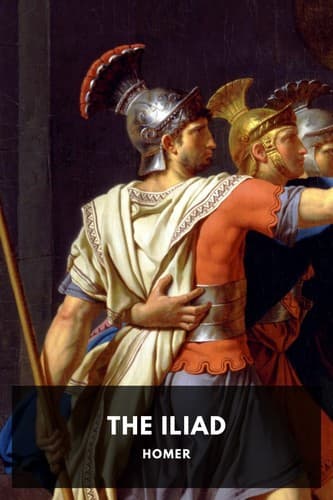
Achilles (Mythological character); Epic poetry, Greek -- Translations into English; Trojan War
“Ah! luckless pair, why did we give you to king Peleus, a mortal; for
ye are free from old age, and immortal? Was it that ye might endure
griefs with unhappy men? For there is not anything at all more wretched
than man, 560 of all, as many as breathe and move over the earth. But
Hector, the son of Priam, shall not be borne by you, even in the
curiously-wrought chariot, for I will not permit it. Is it not enough
that he both possesses those arms, and vainly boasts? But into your
knees and spirit will I cast vigour, that ye may safely bear Automedon
from the battle to the hollow ships; for still will I give glory to
them (the Trojans), to slay, until they reach the well-benched ships,
till the sun set, and sacred darkness come on.”
Footnote 558: (return) Clarke compares Æn. xii. 284, from Ennius, apud
Macrob. vi. 1: “Hastati spargunt hastas, fit ferreus imber.” See
Columna’s notes. p. 82, ed. Hessel. The Scholiast rather interprets it,
of a strong and violent shout, στερεὸς καὶ πολὺ ἰσχυρός.
Footnote 559: (return) See Virg. Æn. xi. 89, sqq. with Servius,
Quintus Calab. iii. 740: Ούδὲ μιν ἄμβροτοι ἵπποι ἀταρβέος Αἰακίδαο
Μίμνον ἀδάκρυτοι παρὰ νήεσιν’ ἀλλὰ καὶ αὐτοὶ Μύροντο σφετέροιο
δαϊκταμένου βασιλῆος. Οὐδ’ ἔθελον μογεροῖσιν ἔτ’ ἀνδράσιν, οὐδὲ μεθ’
ἵπποις Μίσγεσθ’ Ἀργείων, ὀλοὸν περὶ πένθος ἔχοντες.
Footnote 560: (return) On this comfortable and satisfactory sentiment,
see the lugubrious collection of parallel passages in Duport, p. 98.
So saying, he breathed strong vigour into the steeds; and they, shaking
the dust from their manes to the ground, quickly bore the rapid car
amongst the Trojans and Greeks. And against them 561 fought Automedon,
though grieved for his companion, rushing along in his chariot like a
vulture among the geese. For he fled easily from the tumult of the
Trojans, and easily did he rush on, pursuing through the dense throng.
Yet did he not slay the men when he pressed onward to pursue; for it
was by no means possible for him, being alone in the sacred 562 car, to
assault with the spear and to rein in the fleet steeds. At length,
however, a companion, the hero Alcimedon, son of Laërceus, the son of
Æmon, beheld him with his eyes, and stood behind his chariot, and
addressed Automedon:
Footnote 561: (return) The Trojans.
Footnote 562: (return) _I.e._ splendid, of surpassing workmanship.
Others refer the epithet to the divine gift mentioned in ver. 443, to
the fabrication of the chariot by the god Vulcan, or to the origin of
Achilles himself from a goddess.
“Which of the gods, O Automedon, has placed a foolish counsel in thy
bosom, and taken from thee sound judgment; inasmuch as alone thou
fightest in the foremost ranks with the Trojans? Thy companion indeed
is slain; and Hector himself vaunts, having upon his shoulders the
armour of Æacides.”
Him then Automedon, the son of Diores, addressed:
Public-domain text, read in full here on John Shaqi.
Reviews
Reviews
No reviews yet
Be the first to share your thoughts on this work.
Elsewhere in the archive
Join the Discussion
Join the discussion
Sign in to leave a comment or review.
Sign InorCreate an account