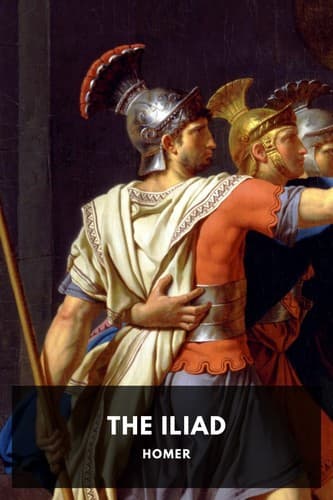
Achilles (Mythological character); Epic poetry, Greek -- Translations into English; Trojan War
Then godlike Alexandros answered him again saying: “Hector, since thy
mind is to blame one that is blameless, some other day might I rather
withdraw me from the war, since my mother bare not even me wholly a
coward. For from the time that thou didst gather the battle of thy
comrades about the ships, from that hour do we abide here, and war with
the Danaans ceaselessly; and our comrades concerning whom thou
inquirest are slain. Only Deiphobos and the strong prince Helenos have
both withdrawn, both of them being wounded in the hand with long
spears, for Kronion kept death away from them. But now lead on,
wheresoever thy heart and spirit bid thee, and we will follow with thee
eagerly, nor methinks shall we lack for valour, as far as we have
strength; but beyond his strength may no man fight, howsoever eager he
be.”
So spake the hero, and persuaded his brother’s heart, and they went
forth where the war and din were thickest, round Kebriones, and noble
Polydamas, and Phalkes, and Orthaios, and godlike Polyphetes, and
Palmys, and Askanios, and Morys, son of Hippotion, who had come in
their turn, out of deep-soiled Askanie, on the morn before, and now
Zeus urged them to fight. And these set forth like the blast of violent
winds, that rushes earthward beneath the thunder of father Zeus, and
with marvellous din doth mingle with the salt sea, and therein are many
swelling waves of the loud roaring sea, arched over and white with
foam, some vanward, others in the rear; even so the Trojans arrayed in
van and rear and shining with bronze, followed after their leaders. And
Hector son of Priam was leading them, the peer of Ares, the bane of
men. In front he held the circle of his shield, thick with hides, and
plates of beaten bronze, and on his temples swayed his shining helm.
And everywhere he went in advance and made trial of the ranks, if
perchance they would yield to him as he charged under cover of his
shield. But he could not confound the heart within the breast of the
Achaians. And Aias, stalking with long strides, challenged him first:
“Sir, draw nigh, wherefore dost thou vainly try to dismay the Argives?
We are in no wise ignorant of war, but by the cruel scourge of Zeus are
we Achaians vanquished. Surely now thy heart hopes utterly to spoil the
ships, but we too have hands presently to hold our own. Verily your
peopled city will long ere that beneath our hands be taken and sacked.
But for thee, I tell thee that the time is at hand, when thou shalt
pray in thy flight to father Zeus, and the other immortal gods, that
thy fair-maned steeds may be fleeter than falcons: thy steeds that are
to bear thee to the city, as they storm in dust across the plain.”
Public-domain text, read in full here on John Shaqi.
Reviews
Reviews
No reviews yet
Be the first to share your thoughts on this work.
Elsewhere in the archive
Join the Discussion
Join the discussion
Sign in to leave a comment or review.
Sign InorCreate an account