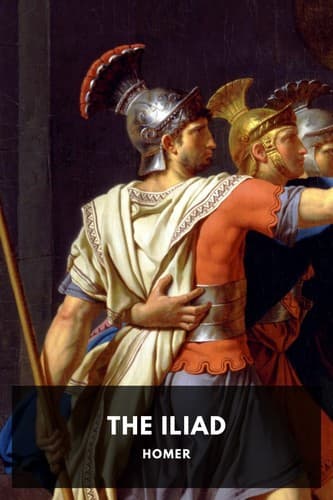
Achilles (Mythological character); Epic poetry, Greek -- Translations into English; Trojan War
Then as he was departing the great Telamonian Aias smote him with a
huge stone; for many stones, the props of swift ships, were rolled
among the feet of the fighters; one of these he lifted, and smote
Hector on the breast, over the shield-rim, near the neck, and made him
spin like a top with the blow, that he reeled round and round. And even
as when an oak falls uprooted beneath the stroke of father Zeus, and a
dread savour of brimstone arises therefrom, and whoso stands near and
beholds it has no more courage, for dread is the bolt of great Zeus,
even so fell mighty Hector straightway in the dust. And the spear fell
from his hand, but his shield and helm were made fast to him, and round
him rang his arms adorned with bronze.
Then with a loud cry they ran up, the sons of the Achaians, hoping to
drag him away, and they cast showers of darts. But not one availed to
wound or smite the shepherd of the host, before that might be the
bravest gathered about him, Polydamas, and Aineias, and goodly Agenor,
and Sarpedon, leader of the Lykians, and noble Glaukos, and of the rest
not one was heedless of him, but they held their round shields in front
of him, and his comrades lifted him in their arms, and bare him out of
the battle, till he reached his swift horses that were standing waiting
for him, with the charioteer and the fair-dight chariot at the rear of
the combat and the war. These toward the city bore him heavily moaning.
Now when they came to the ford of the fair-flowing river, of eddying
Xanthos, that immortal Zeus begat, there they lifted him from the
chariot to the ground, and poured water over him, and he gat back his
breath, and looked up with his eyes, and sitting on his heels kneeling,
he vomited black blood. Then again he sank back on the ground, and
black night covered his eyes, the stroke still conquering his spirit.
Now the Argives when they saw Hector departed rushed yet the more upon
the Trojans, and were mindful of the delight of battle. There far the
foremost did swift Aias, son of Oileus, leap on Satnios, son of Enops,
and wounded him with his sharp spear; Satnios whom the fair Naiad-nymph
bore to Enops as he herded his flocks by the banks of Satnioeis. Him
did the spear-famed son of Oileus draw nigh, and wounded him on the
flank, and he fell, and round him did Trojans and Danaans join in
strong battle. Then to his aid came Polydamas, the wielder of the
spear, son of Panthoos, and smote Prothoenor on the right shoulder,
Prothoenor, son of Areïlykos, and through his shoulder went the mighty
spear, and he fell in the dust, and clutched the earth with his palm.
And Polydamas boasted over him terribly, crying aloud: “Verily methinks
that again from the strong hand of the high-hearted son of Panthoos,
the spear hath not leaped in vain. Nay, one of the Argives hath caught
it in his flesh, and leaning thereon for a staff, methinks that he will
go down within the house of Hades.”
Public-domain text, read in full here on John Shaqi.
Reviews
Reviews
No reviews yet
Be the first to share your thoughts on this work.
Elsewhere in the archive
Join the Discussion
Join the discussion
Sign in to leave a comment or review.
Sign InorCreate an account