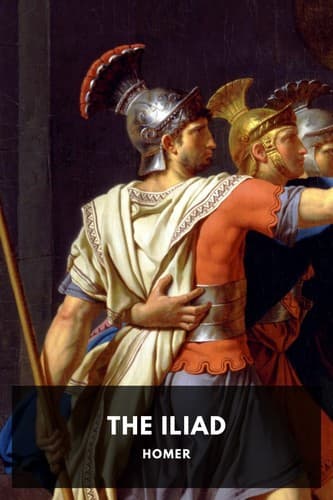
Achilles (Mythological character); Epic poetry, Greek -- Translations into English; Trojan War
Then he answered her again, Poseidon, the Shaker of the earth: “Goddess
Iris, most duly hast thou spoken this word. Yea, an excellent thing is
this, when the bearer of a message has a prudent wit. Yet this is a
terrible grief that cometh on heart and spirit, whenso any desireth to
upbraid with angry words his peer to whom fate hath assigned an equal
share with himself. But verily now will I yield, for all mine anger;
but another thing will I tell thee, and make this threat in my heart,
that if against my will, and the will of Athene, the driver of the
prey, and of Hera and Hermes, and prince Hephaistos, Zeus shall spare
steep Ilios, nor choose utterly to destroy it, and give great might to
the Argives, let him know this, that our wrath will be inappeasable.”
So spake the Shaker of the earth, and left the host of the Achaians,
and passed to the sea, and sank, and sorely they missed him, the heroes
of the Achaians.
Then Zeus, the gatherer of the clouds, spake to Apollo, saying: “Go
now, dear Phoebus, to Hector of the helm of bronze, for, lo, already
the embracer of the world, the Earthshaker, is gone to the bright sea,
shunning our utter wrath, ay, and had he not done so, even the others
would have heard of our strife, even the gods of the nether world, that
are with Kronos. But better far is this, both for me, and for him,
that, despite his wrath, he should yield to my hands, for not without
sweat would this strife have been accomplished. But do thou take in thy
hands the tasselled aegis, and shake it fiercely and affright the
Achaian heroes. But, thou Archer-God, let glorious Hector be thy care,
and rouse in him great wrath even till the Achaians come in their
flight to the ships, and the Hellespont. And from that moment will I
devise word and deed wherewithal the Achaians may take breath again
from their toil.”
So spake he, nor was Apollo deaf to the word of the Father, but he went
down the hills of Ida like a fleet falcon, the bane of doves, that is
the swiftest of flying things. And he found the son of wise-hearted
Priam, noble Hector, sitting up, no longer lying, for he had but late
got back his life, and knew the comrades around him, and his gasping
and his sweat had ceased, from the moment when the will of
aegis-bearing Zeus began to revive him. Then far-darting Apollo stood
near him, and spake to him: “Hector, son of Priam, why dost thou sit
fainting apart from the others? Is it perchance that some trouble
cometh upon thee?”
Then, with faint breath answered him Hector of the glancing helm: “Nay,
but who art thou, best of the gods, who enquirest of me face to face?
Dost thou not know that by the hindmost row of the ships of the
Achaians, Aias of the loud war-cry smote me on the breast with a stone,
as I was slaying his comrades, and made me cease from mine impetuous
might? And verily I deemed that this very day I should pass to the
dead, and the house of Hades, when I had gasped my life away.”
Public-domain text, read in full here on John Shaqi.
Reviews
Reviews
No reviews yet
Be the first to share your thoughts on this work.
Elsewhere in the archive
Join the Discussion
Join the discussion
Sign in to leave a comment or review.
Sign InorCreate an account