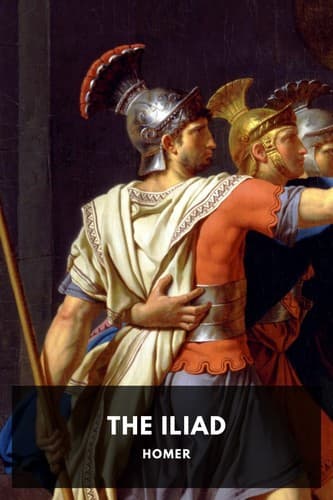
Achilles (Mythological character); Epic poetry, Greek -- Translations into English; Trojan War
So spake he, and they set yet the fiercer on the Argives. And Aias no
longer abode their onset, for he was driven back by the darts, but he
withdrew a little,—thinking that now he should die,—on to the oarsman’s
bench of seven feet long, and he left the decks of the trim ship. There
then he stood on the watch, and with his spear he ever drave the
Trojans from the ships, whosoever brought unwearied fire, and ever he
shouted terribly, calling to the Danaans: “O friends, Danaan heroes,
men of Ares’ company, play the man, my friends, and be mindful of
impetuous valour. Do we deem that there be allies at our backs, or some
wall stronger than this to ward off death from men? Verily there is not
hard by any city arrayed with towers, whereby we might defend
ourselves, having a host that could turn the balance of battle. Nay,
but we are set down in the plain of the mailed men of Troy, with our
backs against the sea, and far off from our own land. Therefore is
safety in battle, and not in slackening from the fight.”
So spake he, and rushed on ravening for battle, with his keen spear.
And whosoever of the Trojans was coming against the ship with blazing
fire, to pleasure Hector at his urging, him would Aias wound, awaiting
him with his long spear, and twelve men in front of the ships at close
quarters did he wound.
BOOK XVI.
How Patroklos fought in the armour of Achilles, and drove the Trojans
from the ships, but was slain at last by Hector.
So they were warring round the well-timbered ship, but Patroklos drew
near Achilles, shepherd of the host, and he shed warm tears, even as a
fountain of dark water that down a steep cliff pours its cloudy stream.
And noble swift-footed Achilles when he beheld him was grieved for his
sake, and accosted him, and spake winged words, saying: “Wherefore
weepest thou, Patroklos, like a fond little maid, that runs by her
mother’s side, and bids her mother take her up, snatching at her gown,
and hinders her in her going, and tearfully looks at her, till the
mother takes her up? like her, Patroklos, dost thou let fall soft
tears. Hast thou aught to tell to the Myrmidons, or to me myself, or is
it some tidings out of Phthia that thou alone hast beard? Or dost thou
lament for the sake of the Argives,—how they perish by the hollow ships
through their own transgression? Speak out, and hide it not within thy
spirit, that we may both know all.”
Public-domain text, read in full here on John Shaqi.
Reviews
Reviews
No reviews yet
Be the first to share your thoughts on this work.
Elsewhere in the archive
Join the Discussion
Join the discussion
Sign in to leave a comment or review.
Sign InorCreate an account