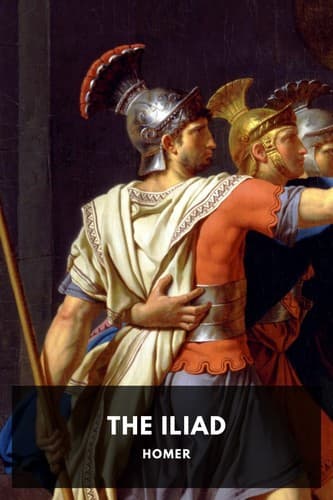
Achilles (Mythological character); Epic poetry, Greek -- Translations into English; Trojan War
So spake he, nor was Apollo disobedient to his father. He went down the
hills of Ida to the dread battle din, and straight way bore goodly
Sarpedon out of the darts, and carried him far away and bathed him in
the streams of the river, and anointed him with ambrosia, and clad him
in garments that wax not old, and sent him to be wafted by fleet
convoy, the twin brethren Sleep and Death, that swiftly set him down in
the rich land of wide Lykia. But Patroklos cried to his horses and
Automedon, and after the Trojans and Lykians went he, and so was
blindly forgetful, in his witlessness, for if he had kept the saying of
the son of Peleus, verily he should have escaped the evil fate of black
death. But ever is the wit of Zeus stronger than the wit of men, so now
he roused the spirit of Patroklos in his breast. There whom first, whom
last didst thou slay, Patroklos, when the gods called thee deathward?
Adrestos first, and Autonoos, and Echeklos, and Perimos, son of Megas,
and Epistor, and Melanippos, and thereafter Elasos, and Moulios, and
Pylartes; these he slew, but the others were each man of them fain of
flight. Then would the sons of the Achaians have taken high-gated Troy,
by the hands of Patroklos, for around and before him he raged with the
spear, but that Phoebus Apollo stood on the well-builded wall, with
baneful thoughts towards Patroklos, and succouring the Trojans. Thrice
clomb Patroklos on the corner of the lofty wall, and thrice did Apollo
force him back and smote the shining shield with his immortal hands.
But when for the fourth time he came on like a god, then cried
far-darting Apollo terribly, and spake winged words: “Give back,
Patroklos of the seed of Zeus! Not beneath thy spear is it fated that
the city of the valiant Trojans shall fall, nay nor beneath Achilles, a
man far better than thou.”
So spake he, and Patroklos retreated far back, avoiding the wrath of
far-darting Apollo. But Hector within the Skaian gates was restraining
his whole-hooved horses, pondering whether he should drive again into
the din and fight, or should call unto the host to gather to the wall.
While thus he was thinking, Phoebus Apollo stood by him in the guise of
a young man and a strong, Asios, who was the mother’s brother of
horse-taming Hector, being own brother of Hekabe, and son of Dymas, who
dwelt in Phrygia, on the streams of Sangarios. In his guise spake
Apollo, son of Zeus, to Hector: “Hector, wherefore dost thou cease from
fight? It doth not behove thee. Would that I were as much stronger than
thou as I am weaker, thereon quickly shouldst thou stand aloof from war
to thy hurt. But come, turn against Patroklos thy strong-hooved horses,
if perchance thou mayst slay him, and Apollo give thee glory.”
Public-domain text, read in full here on John Shaqi.
Reviews
Reviews
No reviews yet
Be the first to share your thoughts on this work.
Elsewhere in the archive
Join the Discussion
Join the discussion
Sign in to leave a comment or review.
Sign InorCreate an account