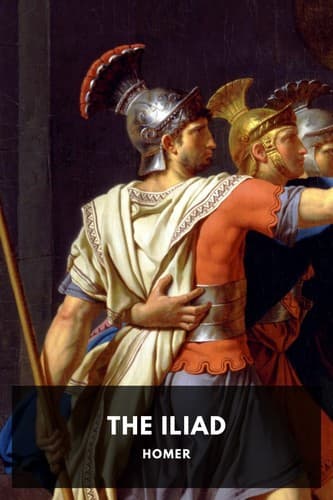
Achilles (Mythological character); Epic poetry, Greek -- Translations into English; Trojan War
Thus spake she wailing. But Hector’s wife knew not as yet, for no true
messenger had come to tell her how her husband abode without the gates,
but in an inner chamber of the lofty house she was weaving a double
purple web, and broidering therein manifold flowers. Then she called to
her goodly-haired handmaids through the house to set a great tripod on
the fire, that Hector might have warm washing when he came home out of
the battle fond heart, and was unaware how, far from all washings,
bright-eyed Athene had slain him by the hand of Achilles. But she heard
shrieks and groans from the battlements, and her limbs reeled, and the
shuttle fell from her hands to earth. Then again among her
goodly-haired maids she spake: “Come two of ye this way with me that I
may see what deeds are done. It was the voice of my husband’s noble
mother that I heard, and in my own breast my heart leapeth to my mouth
and my knees are numbed beneath me: surely some evil thing is at hand
against the children of Priam. Would that such word might never reach
my ear! yet terribly I dread lest noble Achilles have cut off bold
Hector from the city by himself and chased him to the plain and ere
this ended his perilous pride that possessed him, for never would he
tarry among the throng of men but ran out before them far, yielding
place to no man in his hardihood.”
Thus saying she sped through the chamber like one mad, with beating
heart, and with her went her handmaidens. But when she came to the
battlements and the throng of men, she stood still upon the wall and
gazed, and beheld him dragged before the city:—swift horses dragged him
recklessly toward the hollow ships of the Achaians. Then dark night
came on her eyes and shrouded her, and she fell backward and gasped
forth her spirit. From off her head she shook the bright attiring
thereof, frontlet and net and woven band, and veil, the veil that
golden Aphrodite gave her on the day when Hector of the glancing helm
led her forth of the house of Eetion, having given bride-gifts untold.
And around her thronged her husband’s sisters and his brothers’ wives,
who held her up among them, distraught even to death. But when at last
she came to herself and her soul returned into her breast, then wailing
with deep sobs she spake among the women of Troy: “O Hector, woe is me!
to one fate then were we both born, thou in Troy in the house of Priam,
and I in Thebe under woody Plakos, in the house of Eetion, who reared
me from a little one—ill-fated sire of cruel-fated child. Ah, would he
have begotten me not. Now thou to the house of Hades beneath the secret
places of the earth departest, and me in bitter mourning thou leavest a
widow in thy halls: and thy son is but an infant child—son of unhappy
parents, thee and me—nor shalt thou profit him, Hector, since thou art
dead, neither he thee. For even if he escape the Achaians’ woful war,
yet shall labour and sorrow cleave unto him hereafter, for other men
shall seize his lands.
Public-domain text, read in full here on John Shaqi.
Reviews
Reviews
No reviews yet
Be the first to share your thoughts on this work.
Elsewhere in the archive
Join the Discussion
Join the discussion
Sign in to leave a comment or review.
Sign InorCreate an account