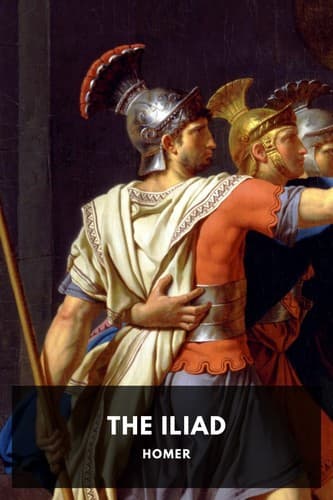
Achilles (Mythological character) -- Poetry; Classical literature; Epic poetry, Greek -- Translations into English; Trojan War -- Poetry
In all these objections we see nothing that contradicts his title to
the honour of the chief invention: and as long as this (which is indeed
the characteristic of poetry itself) remains unequalled by his
followers, he still continues superior to them. A cooler judgment may
commit fewer faults, and be more approved in the eyes of one sort of
critics: but that warmth of fancy will carry the loudest and most
universal applauses which holds the heart of a reader under the
strongest enchantment. Homer not only appears the inventor of poetry,
but excels all the inventors of other arts, in this, that he has
swallowed up the honour of those who succeeded him. What he has done
admitted no increase, it only left room for contraction or regulation.
He showed all the stretch of fancy at once; and if he has failed in
some of his flights, it was but because he attempted everything. A work
of this kind seems like a mighty tree, which rises from the most
vigorous seed, is improved with industry, flourishes, and produces the
finest fruit: nature and art conspire to raise it; pleasure and profit
join to make it valuable: and they who find the justest faults, have
only said that a few branches which run luxuriant through a richness of
nature, might be lopped into form to give it a more regular appearance.
Having now spoken of the beauties and defects of the original, it
remains to treat of the translation, with the same view to the chief
characteristic. As far as that is seen in the main parts of the poem,
such as the fable, manners, and sentiments, no translator can prejudice
it but by wilful omissions or contractions. As it also breaks out in
every particular image, description, and simile, whoever lessens or too
much softens those, takes off from this chief character. It is the
first grand duty of an interpreter to give his author entire and
unmaimed; and for the rest, the diction and versification only are his
proper province, since these must be his own, but the others he is to
take as he finds them.
Public-domain text, read in full here on John Shaqi.
Reviews
Reviews
No reviews yet
Be the first to share your thoughts on this work.
Join the Discussion
Join the discussion
Sign in to leave a comment or review.
Sign InorCreate an account