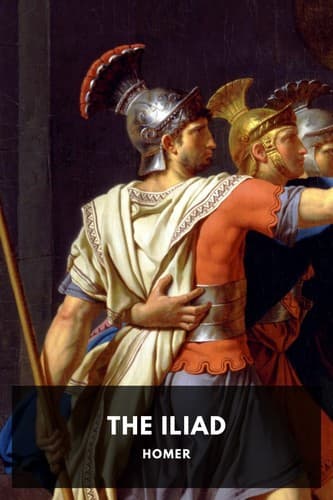
Achilles (Mythological character) -- Poetry; Classical literature; Epic poetry, Greek -- Translations into English; Trojan War -- Poetry
He said, and threw with stalwart hand the spear;
Achilles’ leg he struck, below the knee,
Nor miss’d his aim; and loudly rang the greaves
Of new-wrought tin; but back the brazen point
Rebounded, nor the heav’nly armour pierc’d.
In turn Achilles on Agenor sprang:
But Phoebus robb’d him of his hop’d-for prize,
Who, veil’d in thickest cloud, convey’d away
Antenor’s son, and from the battle bore
To rest in peace; while he by guile withdrew
The son of Peleus from the flying crowd:
For in Agenor’s very likeness clad,
Before him stood the far-destroying King:
Then fled, Achilles hast’ning in pursuit.
He o’er the fertile plain with flying foot
Pursu’d; beside Scamander’s eddying stream
Apollo turn’d, and still but little space
Before him flying, subtly lur’d him on,
Each moment hoping to attain his prize.
Meantime the gen’ral crowd, in panic flight,
With eager haste the city’s refuge sought,
And all the town with fugitives was fill’d.
Nor did they dare without the walls to stand
For mutual aid; nor halt to know what friends
Were safe, who left upon the battle-field;
But through the gates pour’d in the hurrying mass
Who to their active limbs their safety ow’d.
ARGUMENT.
THE DEATH OF HECTOR.
The Trojans being safe within the walls, Hector only stays to oppose
Achilles. Priam is struck at his approach, and tries to persuade his
son to re-enter the town. Hecuba joins his entreaties, but in vain.
Hector consults within himself what measures to take; but, at the
advance of Achilles, his resolution fails him, and he flies: Achilles
pursues him thrice round the walls of Troy. The gods debate concerning
the fate of Hector; at length Minerva descends to the aid of Achilles.
She deludes Hector in the shape of Deiphobus; he stands the combat, and
is slain. Achilles drags the dead body at his chariot, in the sight of
Priam and Hecuba. Their lamentations, tears, and despair. Their cries
reach the ears of Andromache, who, ignorant of this, was retired into
the inner part of the palace; she mounts up to the walls, and beholds
her dead husband. She swoons at the spectacle. Her excess of grief and
lamentation.
The thirtieth day still continues. The scene lies under the walls, and
on the battlements of Troy.
BOOK XXII.
Thus they from panic flight, like timorous fawns.
Within the walls escaping, dried their sweat,
And drank, and quench’d their thirst, reclining safe
On the fair battlements; but nearer drew,
With slanted shields, the Greeks; yet Hector still
In front of Ilium and the Scaean gate,
Stay’d by his evil doom, remain’d without;
Then Phoebus thus to Peleus’ godlike son:
“Achilles, why with active feet pursue,
Thou mortal, me Immortal? know’st thou not
My Godhead, that so hot thy fury burns?
Or heed’st thou not that all the Trojan host
Whom thou hast scar’d, while thou art here withdrawn,
Within the walls a refuge safe have found?
On me thy sword is vain! I know not death!”
Public-domain text, read in full here on John Shaqi.
Reviews
Reviews
No reviews yet
Be the first to share your thoughts on this work.
Elsewhere in the archive
Join the Discussion
Join the discussion
Sign in to leave a comment or review.
Sign InorCreate an account