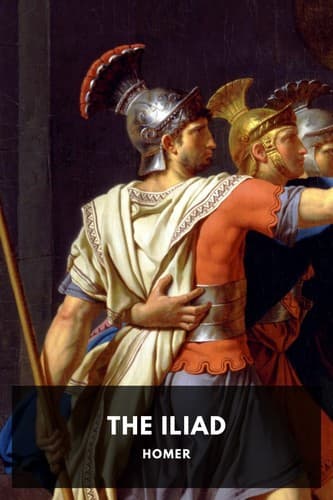
Achilles (Mythological character) -- Poetry; Classical literature; Epic poetry, Greek -- Translations into English; Trojan War -- Poetry
Enrag’d, Achilles, swift of foot, replied:
“Deep is the injury, far-darting King,
Most hostile of the Gods, that at thy hand
I bear, who here hast lur’d me from the walls,
Which many a Trojan else had fail’d to reach,
Ere by my hand they bit the bloody dust.
Me of immortal honour thou hast robb’d,
And them, thyself from vengeance safe, hast sav’d.
Had I the pow’r, that vengeance thou shouldst feel.”
Thus saying, and on mightiest deeds intent,
He turn’d him city-ward, with fiery speed;
As when a horse, contending for the prize,
Whirls the swift car, and stretches o’er the plain,
E’en so, with active limbs, Achilles rac’d.
Him first the aged Priam’s eyes discern’d,
Scouring the plain, in arms all dazzling bright,
Like to th’ autumnal star, whose brilliant ray
Shines eminent amid the depth of night,
Whom men the dog-star of Orion call;
The brightest he, but sign to mortal man
Of evil augury, and fiery heat:
So shone the brass upon the warrior’s breast.
The old man groan’d aloud, and lifting high
His hands, he beat his head, and with loud voice
Call’d on his son, imploring; he, unmov’d,
Held post before the gates, awaiting there
Achilles’ fierce encounter; him his sire,
With hands outstretch’d and piteous tone, address’d:
“Hector, my son, await not here alone
That warrior’s charge, lest thou to fate succumb,
Beneath Pelides’ arm, thy better far!
Accurs’d be he! would that th’ immortal Gods
So favour’d him as I! then should his corpse
Soon to the vultures and the dogs be giv’n!
(So should my heart a load of anguish lose)
By whom I am of many sons bereav’d,
Many and brave, whom he has slain, or sold
To distant isles in slav’ry; and e’en now,
Within the city walls I look in vain
For two, Lycaon brave, and Polydore,
My gallant sons, by fair Laothoe:
If haply yet they live, with brass and gold
Their ransom shall be paid; good store of these
We can command; for with his daughter fair
A wealthy dowry aged Altes gave.
But to the viewless shades should they have gone,
Deep were their mother’s sorrow and my own;
But of the gen’ral public, well I know
Far lighter were the grief, than if they heard
That thou hadst fall’n beneath Achilles’ hand.
Then enter now, my son, the city gates,
And of the women and the men of Troy,
Be still the guardian; nor to Peleus’ son,
With thine own life, immortal glory give.
Look too on me with pity; me, on whom,
E’en on the threshold of mine age, hath Jove
A bitter burthen cast, condemn’d to see
My sons struck down, my daughters dragg’d away
In servile bonds; our chambers’ sanctity
Invaded; and our babes by hostile hands
Dash’d to the ground; and by ferocious Greeks
Enslav’d the widows of my slaughter’d sons.
On me at last the rav’ning dogs shall feed,
When by some foeman’s hand, by sword or lance,
My soul shall from my body be divorc’d;
Those very dogs which I myself have bred,
Fed at my table, guardians of my gate,
Shall lap my blood, and over-gorg’d shall lie
E’en on my threshold. That a youth should fall
Public-domain text, read in full here on John Shaqi.
Reviews
Reviews
No reviews yet
Be the first to share your thoughts on this work.
Elsewhere in the archive
Join the Discussion
Join the discussion
Sign in to leave a comment or review.
Sign InorCreate an account