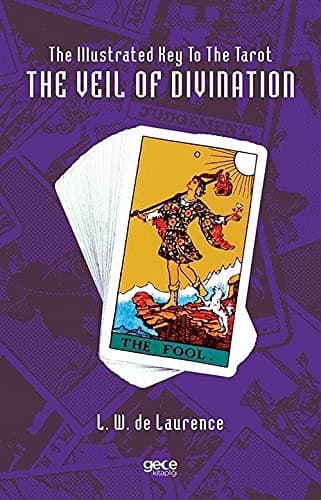
The Illustrated Key to the Tarot: The Veil of Divination — John Shaqi
The Illustrated Key to the Tarot: The Veil of DivinationDe Laurence, L. W. (Lauron William)
Religion
The Illustrated Key to the Tarot: The Veil of Divination
De Laurence, L. W. (Lauron William)
Fortune-telling by cards; Tarot
That combination may, ex hypothesi, reside in the numbered
sequence of its series or in their fortuitous assemblage by shuffling,
cutting and dealing, as in ordinary games of chance played
with cards. Two writers have adopted the first view without
prejudice to the second, and I shall do well, perhaps, to dispose at
once of what they have said. Mr. MacGregor Mathers, who
once published a pamphlet on the Tarot, which was in the main
devoted to fortune-telling, suggested that the twenty-two Trumps
Major could be constructed, following their numerical order, into
what he called a "connected sentence." It was, in fact, the heads
of a moral thesis on the human will, its enlightenment by science,
represented by the Magician, its manifestation by action—a significance
attributed to the High Priestess—its realization (the
Empress) in deeds of mercy and beneficence, which qualities
were allocated to the Emperor. He spoke also in the familiar
conventional manner of prudence, fortitude, sacrifice, hope and
ultimate happiness. But if this were the message of the cards, it
is certain that there would be no excuse for publishing them at
this day or taking the pains to elucidate them at some length. In
his Tarot Of The Bohemians, a work written with zeal and enthusiasm,
sparing no pains of thought or research within its particular
lines—but unfortunately without real insight—Dr. Papus has
given a singularly elaborate scheme of the Trumps Major. It
depends, like that of Mr. Mathers, from their numerical
sequence, but exhibits their interrelation in the Divine World, the
Macrocosm and Microcosm. In this manner we get, as it were,
a spiritual history of man, or of the soul coming out from the
Eternal, passing into the darkness of the material body, and
returning to the height. I think that the author is here within a
measurable distance of the right track, and his views are to this
extent informing, but his method—in some respects—confuses
the issues and the modes and planes of being.
Public-domain text, read in full here on John Shaqi.
Reviews
Reviews
No reviews yet
Be the first to share your thoughts on this work.
Join the Discussion
Join the discussion
Sign in to leave a comment or review.
Sign InorCreate an account