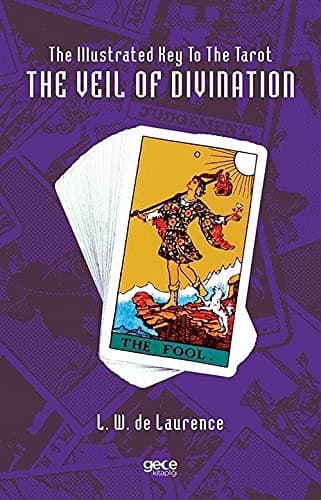
The Illustrated Key to the Tarot: The Veil of DivinationDe Laurence, L. W. (Lauron William)
Religion
The Illustrated Key to the Tarot: The Veil of Divination
De Laurence, L. W. (Lauron William)
Fortune-telling by cards; Tarot
These are exceedingly rare and were frankly among the works
of colportage of their particular period. They contain the most
curious fragments on matters within and without the main issue,
lucubrations on genii, magic, astrology, talismans, dreams, etc. I
have spoken sufficiently in the text on the author's views on the
Tarot and his place in its modern history. He regarded it as a
work of speaking hieroglyphics, but to translate it was not easy.
He, however, accomplished the task—that is to say, in his own
opinion.
III
An Inquiry into the Ancient Greek Game, supposed to have been
invented by Palamedes. (By James Christie.) London:
4to, 1801.
I mention this collection of curious dissertations because it has
been cited by writers on the Tarot. It seeks to establish a close
connection between early games of antiquity and modern chess.
It is suggested that the invention attributed to Palamedes, prior
to the Siege of Troy, was known in China from a more remote
period of antiquity. The work has no reference to cards of any
kind whatsoever.
IV
Researches into the History of Playing Cards. By Samuel Weller
Singer. 4to, London, 1816.
The Tarot is probably of Eastern origin and high antiquity,
but the rest of Court de Gebelin's theory is vague and unfounded.
Cards were known in Europe prior to the appearance of the
Egyptians. The work has a good deal of curious information and
the appendices are valuable, but the Tarot occupies comparatively
little of the text and the period is too early for a tangible criticism
of its claims. There are excellent reproductions of early
specimen designs. Those of Court de Gebelin are also given in
extenso.
V
Facts and Speculations on Playing Cards. By W. A. Chatto.
8vo, London, 1848.
The author suggested that the Trumps Major and the numeral
cards were once separate, but were afterwards combined. The
oldest specimens of Tarot cards are not later than 1440. But the
claims and value of the volume have been sufficiently described
in the text.
VI
Les Cartes à Jouer et la Cartomancie. Par D. R. P. Boiteau
d'Ambly. 4to, Paris, 1854.
There are some interesting illustrations of early Tarot cards,
which are said to be of Oriental origin; but they are not referred
to Egypt. The early gipsy connection is affirmed, but there is
no evidence produced. The cards came with the gipsies from
India, where they were designed to show forth the intentions of
"the unknown divinity" rather than to be the servants of profane
amusement.
VII
Dogme et Rituel de la Haute Magie. Par Eliphas Lévi, 2 vols.,
demy 8vo, Paris, 1854.
Public-domain text, read in full here on John Shaqi.
Reviews
Reviews
No reviews yet
Be the first to share your thoughts on this work.
Elsewhere in the archive
Join the Discussion
Join the discussion
Sign in to leave a comment or review.
Sign InorCreate an account