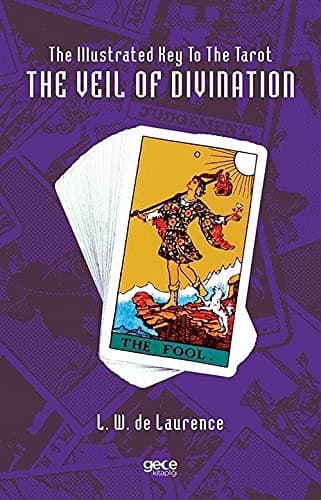
The Illustrated Key to the Tarot: The Veil of DivinationDe Laurence, L. W. (Lauron William)
Religion
The Illustrated Key to the Tarot: The Veil of Divination
De Laurence, L. W. (Lauron William)
Fortune-telling by cards; Tarot
The frontispiece to this work represents the absolute Key of
the occult sciences, given by William Postel and completed by the
writer. It is reproduced in The Tarot Of The Bohemians, and
in the preface which I have prefixed thereto, as indeed elsewhere,
I have explained that Postel never constructed a hieroglyphical
key. Eliphas Lévi identifies the Tarot as that sacred alphabet
which has been variously referred to Enoch, Thoth, Cadmus and
Palamedes. It consists of absolute ideas attached to signs and
numbers. In respect of the latter, there is an extended commentary
on these as far as the number 19, the series being interpreted
as the Keys of Occult Theology. The remaining three
numerals which complete the Hebrew alphabet are called the
Keys of Nature. The Tarot is said to be the original of Chess,
as it is also of the Royal Game of Goose. This volume contains
the author's hypothetical reconstruction of the tenth Trump
Major, showing Egyptian figures on the Wheel of Fortune.
XI
L'Homme Rouge des Tuileries. Par P. Christian. Fcap. 8vo,
Paris, 1863.
The work is exceedingly rare, is much sought and was once
highly prized in France; but Dr. Papus has awakened to the
fact that it is really of slender value, and the statement might
be extended. It is interesting, however, as containing the writer's
first reveries on the Tarot. He was a follower and imitator of
Lévi. In the present work, he provides a commentary on the
Trumps Major and thereafter the designs and meanings of all
the Minor Arcana. There are many and curious astrological
attributions. The work does not seem to mention the Tarot by
name. A later Histoire de la Magie does little more than reproduce
and extend the account of the Trumps Major given herein.
XII
The History of Playing Cards. By E. S. Taylor. Cr. 8vo. London,
1865.
This was published posthumously and is practically a translation
of Boiteau. It therefore calls for little remark on my part.
The opinion is that cards were imported by the gipsies from
India. There are also references to the so-called Chinese Tarot,
which was mentioned by Court de Gebelin.
XIII
Origine des Cartes à Jouer. Par Romain Merlin. 4to, Paris,
1869.
There is no basis for the Egyptian origin of the Tarot, except
in the imagination of Court de Gebelin. I have mentioned otherwise
that the writer disposes to his personal satisfaction, of the
gipsy hypothesis, and he does the same in respect of the imputed
connection with India; he says that cards were known in
Europe before communication was opened generally with that
world about 1494. But if the gipsies were a Pariah tribe already
dwelling in the West, and if the cards were a part of their baggage,
there is nothing in this contention. The whole question is
essentially one of speculation.
XIV
The Platonist. Vol. II, pp. 126-8. Published at St. Louis, Mo.,
U.S.A., 1884-5. Royal 4to.
Public-domain text, read in full here on John Shaqi.
Reviews
Reviews
No reviews yet
Be the first to share your thoughts on this work.
Elsewhere in the archive
Join the Discussion
Join the discussion
Sign in to leave a comment or review.
Sign InorCreate an account