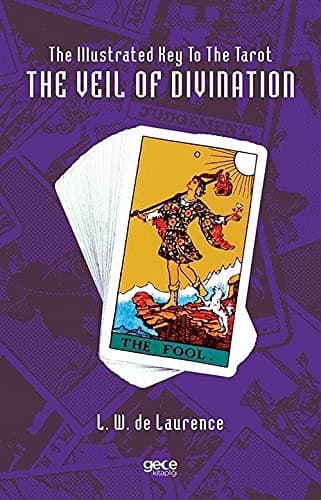
The Illustrated Key to the Tarot: The Veil of DivinationDe Laurence, L. W. (Lauron William)
Religion
The Illustrated Key to the Tarot: The Veil of Divination
De Laurence, L. W. (Lauron William)
Fortune-telling by cards; Tarot
This periodical, the suspension of which must have been regretted
by many admirers of an unselfish and laborious effort,
contained one anonymous article on the Tarot by a writer with
theosophical tendencies, and considerable pretensions to knowledge.
It has, however, by its own evidence, strong titles to
negligence, and is indeed a ridiculous performance. The word
Tarot is the Latin Rota = wheel, transposed. The system was
invented at a remote period in India, presumably—for the writer
is vague—about B. C. 300. The Fool represents the primordial
chaos. The Tarot is now used by Rosicrucian adepts, but in spite
of the inference that it may have come down to them from their
German progenitors in the early seventeenth century, and notwithstanding
the source in India, the twenty-two keys were
pictured on the walls of Egyptian temples dedicated to the mysteries
of initiation. Some of this rubbish is derived from P.
Christian, but the following statement is peculiar, I think, to
the writer: "It is known to adepts that there should be twenty-two
esoteric keys, which would make the total number up to
100." Persons who reach a certain stage of lucidity have only
to provide blank pasteboards of the required number and the
missing designs will be furnished by superior intelligences.
Meanwhile, America is still awaiting the fulfilment of the concluding
forecast, that some few will ere long have so far developed
in that country "as to be able to read perfectly ... in that
perfect and divine sybilline work, the Taro." Perhaps the cards
which accompany the present volume will give the opportunity
and the impulse!
XV
Lo Joch de Naips. Per Joseph Brunet y Bellet. Cr. 8vo, Barcelona,
1886.
With reference to the dream of Egyptian origin, the author
quotes E. Garth Wilkinson's Manners and Customs of the
Egyptians as negative evidence at least that cards were unknown
in the old cities of the Delta. The history of the subject is
sketched, following the chief authorities, but without reference
to exponents of the occult schools. The mainstay throughout
is Chatto. There are some interesting particulars about the prohibition
of cards in Spain, and the appendices include a few
valuable documents, by one of which it appears, as already mentioned,
that St. Bernardin of Sienna preached against games in
general, and cards in particular, so far back as 1423. There are
illustrations of rude Tarots, including a curious example of an
Ace of Cups, with a phoenix rising therefrom, and a Queen of
Cups, from whose vessel issues a flower.
XVI
The Tarot: Its Occult Significance, Use in Fortune-Telling, and
Method of Play. By S. L. MacGregor Mathers. Sq. 16mo,
London, 1888.
Public-domain text, read in full here on John Shaqi.
Reviews
Reviews
No reviews yet
Be the first to share your thoughts on this work.
Elsewhere in the archive
Join the Discussion
Join the discussion
Sign in to leave a comment or review.
Sign InorCreate an account