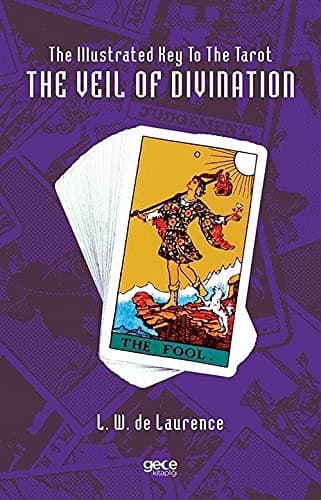
The Illustrated Key to the Tarot: The Veil of DivinationDe Laurence, L. W. (Lauron William)
Religion
The Illustrated Key to the Tarot: The Veil of Divination
De Laurence, L. W. (Lauron William)
Fortune-telling by cards; Tarot
The text is accompanied by what is termed a complete reconstitution
of all the symbols, which means that in this manner we
have yet another Tarot. The Trumps Major follow the traditional
lines, with various explanations and attributions on the
margins, and this plan obtains throughout the series. From the
draughtsman's point of view, it must be said that the designs
are indifferently done, and the reproductions seem worse than
the designs. This is probably of no especial importance to the
class of readers addressed. Dr. Papus also presents, by way
of curious memorials, the evidential value of which he seems to
accept implicitly, certain unpublished designs of Eliphas Lévi;
they are certainly interesting as examples of the manner in
which the great occultist manufactured the archæology of the
Tarot to bear out his personal views. We have (a) Trump
Major, No. 5, being Horus as the Grand Hierophant; drawn
after the monuments; (b) Trump Major No. 2, being the High
Priestess as Isis, also after the monuments; and (c) five imaginary
specimens of an Indian Tarot. This is how la haute science
in France contributes to the illustration of that work which Dr.
Papus terms livre de la science éternelle; it would be called by
rougher names in English criticism. The editor himself takes
his usual pains and believes that he has discovered the time attributed
to each card by ancient Egypt. He applies it to the
purpose of divination, so that the skilful fortune-teller can now
predict the hour and the day when the dark young man will meet
with the fair widow, and so forth.
XXVIII
Le Tarot des Bohémiens. Par Papus. 8vo, Paris, 1889. English
Translation, second edition, 1910.
An exceedingly complex work, which claims to present an absolute
key to occult science. It was translated into English by
Mr. A. P. Morton in 1896, and this version has been re-issued
recently under my own supervision. The preface which I have
prefixed thereto contains all that it is necessary to say regarding
its claims, and it should be certainly consulted by readers of
the present Pictorial Key to the Tarot. The fact that Papus
regards the great sheaf of hieroglyphics as "the most ancient
book in the world," as "the Bible of Bibles," and therefore as
"the primitive revelation," does not detract from the claim of
his general study, which—it should be added—is accompanied
by numerous valuable plates, exhibiting Tarot codices, old and
new, and diagrams summarizing the personal thesis of the
writer and of some others who preceded him. The Tarot of the
Bohemians is published at 6s. by William Rider & Son, Ltd.
XXIX
Manuel Synthétique et Pratique du Tarot. Par Eudes Picard.
8vo, Paris, 1909.
Public-domain text, read in full here on John Shaqi.
Reviews
Reviews
No reviews yet
Be the first to share your thoughts on this work.
Elsewhere in the archive
Join the Discussion
Join the discussion
Sign in to leave a comment or review.
Sign InorCreate an account