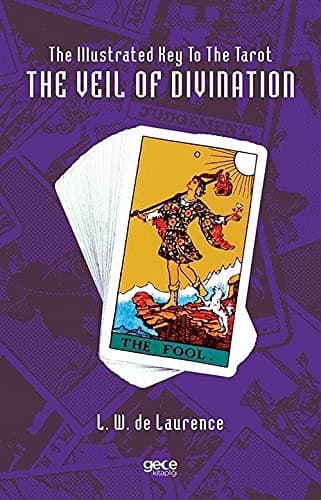
The Illustrated Key to the Tarot: The Veil of DivinationDe Laurence, L. W. (Lauron William)
Religion
The Illustrated Key to the Tarot: The Veil of Divination
De Laurence, L. W. (Lauron William)
Fortune-telling by cards; Tarot
It is a vast commentary on the second septenary of the Trumps
Major. Justice signifies equilibrium and its agent; the Hermit
typifies the mysteries of solitude; the Wheel of Fortune is the
circulus of becoming or attaining; Fortitude signifies the power
resident in will; the Hanged Man is magical bondage, which
speaks volumes for the clouded and inverted insight of this fantasiast
in occultism; Death is, of course, that which its name signifies,
but with reversion to the second death; Temperance means
the magic of transformations, and therefore suggests excess
rather than abstinence. There is more of the same kind of
thing—I believe—in the first book, but this will serve as a specimen.
The demise of Stanislas de Guaita put an end to his
scheme of interpreting the Tarot Trumps, but it should be understood
that the connection is shadowy and that actual references
could be reduced to a very few pages.
XXV
Le Tarot: Aperçu historique. Par. J. J. Bourgeat. Sq. 12mo,
Paris, 1906.
The author has illustrated his work by purely fantastic designs
of certain Trumps Major, as, for example, the Wheel of
Fortune, Death and the Devil. They have no connection with
symbolism. The Tarot is said to have originated in India,
whence it passed to Egypt. Eliphas Lévi, P. Christian, and J. A.
Vaillant are cited in support of statements and points of view.
The mode of divination adopted is fully and carefully set out.
XXVI
L'Art de tirer les Cartes. Par Antonio Magus. Cr. 8vo, Paris,
n.d. (about 1908).
This is not a work of any especial pretension, nor has it any
title to consideration on account of its modesty. Frankly, it is
little—if any—better than a bookseller's experiment. There is a
summary account of the chief methods of divination, derived
from familiar sources; there is a history of cartomancy in
France; and there are indifferent reproductions of Etteilla Tarot
cards, with his meanings and the well-known mode of operation.
Finally, there is a section on common fortune-telling by a piquet
set of ordinary cards: this seems to lack the only merit that it
might have possessed, namely, perspicuity; but I speak with reserve,
as I am not perhaps a judge possessing ideal qualifications
in matters of this kind. In any case, the question signifies
nothing. It is just to add that the concealed author maintains
what he terms the Egyptian tradition of the Tarot, which is the
Great Book of Thoth. But there is a light accent throughout his
thesis, and it does not follow that he took the claim seriously.
XXVII
Le Tarot Divinatoire: Clef du tirage des cartes et des sorts.
Par le Dr. Papus. Demy. 8vo, Paris, 1909.
Public-domain text, read in full here on John Shaqi.
Reviews
Reviews
No reviews yet
Be the first to share your thoughts on this work.
Elsewhere in the archive
Join the Discussion
Join the discussion
Sign in to leave a comment or review.
Sign InorCreate an account