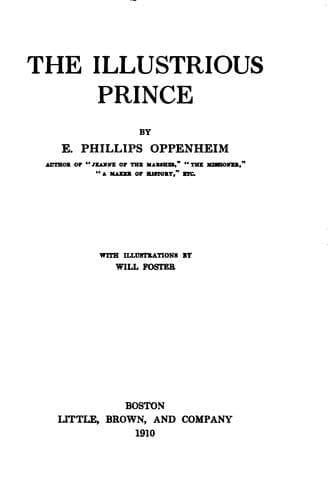
The Illustrious PrinceOppenheim, E. Phillips (Edward Phillips)
General
The Illustrious Prince
Oppenheim, E. Phillips (Edward Phillips)
Detective and mystery stories; Princes -- Fiction
He left her with a little sympathetic murmur, and closed the door behind
him. The girl raised her veil now and spread the newspaper out on
the table before her. There was an account of the tragedy; there were
interviews with some of the passengers, a message from the captain. In
all, it seemed that wonderfully little was known of Mr. Hamilton Fynes.
He had spoken to scarcely a soul on board, and had remained for the
greater part of the time in his stateroom. The captain had not even
been aware of his existence till the moment when Mr. Hamilton Fynes
had sought him out and handed him an order, signed by the head of his
company, instructing him to obey in any respect the wishes of this
hitherto unknown passenger. The tug which had been hired to meet him had
gone down the river, so it was not possible, for the moment, to say by
whom it had been chartered. The station-master at Liverpool knew nothing
except that the letter presented to him by the dead man was a personal
one from a great railway magnate, whose wishes it was impossible to
disregard. There had not been a soul, apparently, upon the steamer
who had known anything worth mentioning of Mr. Hamilton Fynes or his
business. No one in London had made inquiries for him or claimed his few
effects. Half a dozen cables to America remained unanswered.
That papers had been stolen from him--papers or money--was evident from
the place of concealment in his coat, where the lining had been torn
away, but there was not the slightest evidence as to the nature of these
documents or the history of the murdered man. All that could be done was
to await the news from the other side, which was momentarily expected.
The girl went through it all, line by line, almost word by word.
Whatever there might have been of relationship or friendship between her
and the dead man, the news of his terrible end left her shaken, indeed,
but dry-eyed. She was apparently more terrified than grieved, and now
that the first shock had passed away, her mind seemed occupied with
thoughts which may indeed have had some connection with this tragedy,
but were scarcely wholly concerned with it. She sat for a long while
with her hands still resting upon the table but her eyes fixed out of
the window. Then at last she rose and made her way outside. Her friend
the reception clerk was engaged in conversation with one or two men, a
conversation of which she was obviously the subject. As she opened the
door, one of them broke off in the midst of what he was saying and would
have accosted her. The clerk, however, interposed, and drew her a step
or two back into the room.
“Madam,” he said, “one of these gentlemen is from Scotland Yard, and
the others are reporters. They are all eager to know anything about Mr.
Hamilton Fynes. I expect they will want to ask you some questions.”
The girl opened her lips and closed them again.
“I regret to say that I have nothing whatever to tell them,” she
declared. “Will you kindly let them know that?”
Public-domain text, read in full here on John Shaqi.
Reviews
Reviews
No reviews yet
Be the first to share your thoughts on this work.
Join the Discussion
Join the discussion
Sign in to leave a comment or review.
Sign InorCreate an account