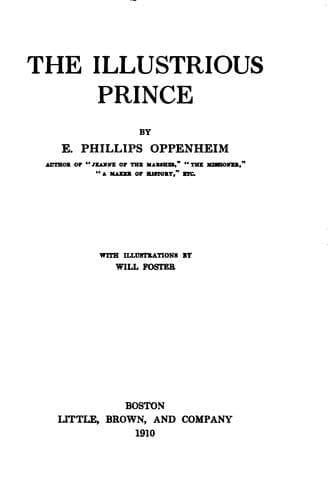
The Illustrious PrinceOppenheim, E. Phillips (Edward Phillips)
General
The Illustrious Prince
Oppenheim, E. Phillips (Edward Phillips)
Detective and mystery stories; Princes -- Fiction
“Hamilton Fynes,” he said, “so far as I knew him, was a quiet,
inoffensive sort of creature, who has been drawing a regular salary from
the State for the last fifteen years and saving half of it. He has been
coming over to Europe now and then, and though he was a good, steady
chap enough, he liked his fling when he was over here, and between you
and me, he was the greatest crank I ever struck. I met him in London a
matter of three years ago, and he wanted to go to Paris. There were
two cars running at the regular time, meeting the boat at Dover. Do you
think he would have anything to do with them? Not he! He hired a special
train and went down like a prince.”
“What did he do that for?” the reporter asked.
“Why, because he was a crank, sir,” Mr. Coulson answered confidentially.
“There was no other reason at all. Take this last voyage on the
Lusitania, now. He spoke to me the first day out because he couldn’t
help it, but for pretty well the rest of the journey he either kept
down in his stateroom or, when he came up on deck, he avoided me and
everybody else. When he did talk, his talk was foolish. He was a good
chap at his work, I believe, but he was a crank. Seemed to me sometimes
as though that humdrum life of his had about turned his brain. The
last day out he was fidgeting all the time; kept looking at his watch,
studying the chart, and asking the sailors questions. Said he wanted to
get up in time to take a girl to lunch on Thursday. It was just for that
reason that he scuttled off the boat without a word to any of us, and
rushed up to London.”
“But he had letters, Mr. Coulson,” the reporter reminded him, “from
some one in Washington, to the captain of the steamer and to the
station-master of the London and North Western Railway. It seems rather
odd that he should have provided himself with these, doesn’t it?”
“They were easy enough to get,” Mr. Coulson answered. “He wasn’t a
worrying sort of chap, Fynes wasn’t. He did his work, year in and year
out, and asked no favors. The consequence was that when he asked a queer
one he got it all right. It’s easier to get a pull over there than it is
here, you know.”
“This is all very interesting,” the reporter said, “and I am sure I’m
very much obliged to you, Mr. Coulson. Now can you tell me of anything
in the man’s life or way of living likely to provoke enmity on the part
of any one? This murder was such a cold-blooded affair.”
“There I’m stuck,” Mr. Coulson admitted. “There’s only one thing I can
tell you, and that is that I believe he had a lot more money on him than
the amount mentioned in your newspapers this morning. My own opinion is
that he was murdered for what he’d got. A smart thief would say that a
fellow who takes a special tug off the steamer and a special train
to town was a man worth robbing. How the thing was done I don’t
know--that’s for your police to find out--but I reckon that whoever
killed him did it for his cash.”
Public-domain text, read in full here on John Shaqi.
Reviews
Reviews
No reviews yet
Be the first to share your thoughts on this work.
Join the Discussion
Join the discussion
Sign in to leave a comment or review.
Sign InorCreate an account