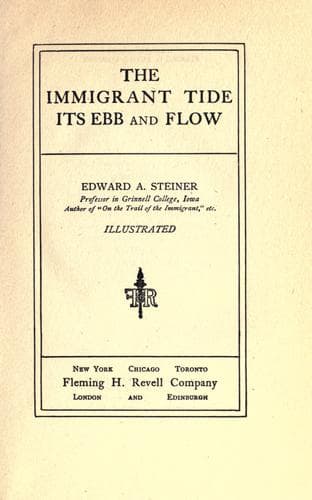
The Immigrant Tide, Its Ebb and FlowSteiner, Edward Alfred
History
The Immigrant Tide, Its Ebb and Flow
Steiner, Edward Alfred
United States -- Emigration and immigration
"We came to America with red cheeks, like the cheeks of summer apples,
and now look at us. We are going back looking like cucumbers in the
autumn."
Yes, their cheeks were pale and pinched and their skin wrinkled. How
could it be otherwise? They had lived for years by the coke ovens of
Pennsylvania, breathing sulphur with every breath; their eyes had rarely
seen the full daylight and their cheeks had not often felt the warm
sunlight. America "ne dobre."
And yet something must have seemed good to them; for they wore American
clothes. Long, trailing skirts, shirt-waists with abbreviated sleeves
and belts with showy buckles. All of them had children, many children of
varying sizes, and among the children not one said: "America ne dobre."
The boys had penetrated into the mysteries of baseball vernacular, and
one of them was the short-stop on his team.
When I inquired of him just what a short-stop is, he looked at me
pityingly and said: "Say, are you a greenhorn?"
I am sure if I had told him that I was a college professor, he would
have asked for my credentials.
Some of the girls, besides having gone to our public schools, belonged
to clubs, wore pins and buttons and chewed gum most viciously. All were
loath to go to the "Stary Kray."
I surely was in my element, the human element; with babies to cuddle, to
guess their ages and their weight; to watch the boisterous, half
Americanized, mysterious youth and to ask questions and answer them
among these strong, friendly men.
There was one woman who neither smiled at me nor answered my greeting;
who held her half-clothed, puny baby close to her breast, giving him his
evening meal. Other little ones, seemingly all of one age, huddled close
to the mother, who looked like a great, frightened bird hovering over
her young.
"Her man been killed in the mine," the women said, and I found no more
questions to ask her. I could only sympathize with her in her grief; for
I knew it. I knew it because I had seen her or her kind, by the hundreds
at a time, prone on the ground beside the yawning pit, claiming some
unrecognizable form as that of husband or son; often of husband and son.
I have heard the bitter wails and lamentations of a whole hillside. Out
of each hut they came, the heart-broken cries of the living over the
dead; and in that grief, the Slovak, the Polish or the Italian women
were just like the American woman, who more silently, perhaps, grieved
over her husband, the foreman of the mine. In the radiant morning he
walked away from her and home; into the mine, his tomb.
The poor Slav woman had paid the price for her American hopes and had a
right to say: "America ne dobre"; but she did not say it.
"Lift my boy!" a rather muscular, good-looking man said, in the English
of New York's East Side. He seemed a little jealous of the attention I
had paid to these strange children.
"He's the real stuff," he continued. "A genuine Yankee boy. Born on the
East Side."
"My! But he's heavy!"
Public-domain text, read in full here on John Shaqi.
Reviews
Reviews
No reviews yet
Be the first to share your thoughts on this work.
Join the Discussion
Join the discussion
Sign in to leave a comment or review.
Sign InorCreate an account