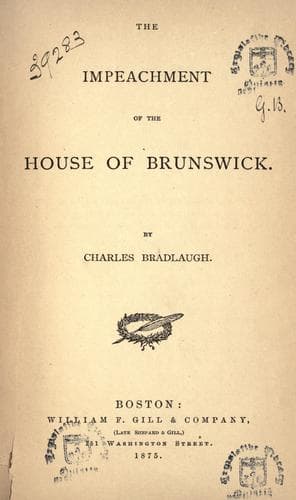
The Impeachment of the House of BrunswickBradlaugh, Charles
History
The Impeachment of the House of Brunswick
Bradlaugh, Charles
Great Britain -- History -- 1714-1837; Hanover, House of
Her Majesty's eldest son, Albert Edward, Prince of Wales, Duke of
Saxony, Cornwall, and Rothesay, and Earl of Dublin, has earned already
so wide a fame that notice here is almost needless. As a writer, his
letters--a few of which have been published by the kind permission
of Sir Charles Mordaunt--illustrate the grasp of mind peculiar to the
family, and mark in strong relief the nobility of character of the
Royal author. As a military chieftain, the Autumn Manoeuvres of 1871
demonstrated the tact and speed he could display in a strategic movement
of masterly retreat. As an investigator of social problems, he has
surpassed the Lords Townshend and Shaftesbury, and at Mabille and in
London has, by experience, entitled himself to speak with authority.
As a pigeon-shooter, he can only be judged by comparison with the
respectable ex-bushranger now claiming the Tichborne estates. Here,
it is true, the latter is a man of more weight. The Prince of Wales
receives £40,000 a year, and we give his wife £10,000 a year as a slight
acknowledgment for the position she has to occupy as Princess of Wales.
With the history of the wives of the two last Princes of Wales to guide
them, it is almost wonderful that the advisers of the Princess did not
insist on a much higher premium against the risks of the position. When
his Royal Highness came of age, he found accumulations of the Duchy of
Cornwall approaching a million sterling, which, invested in Consols,
would bring him in at least a further £40,000 per annum. His Royal
Highness also has the income of the Duchy of Cornwall, amounting net
to about £75,000 a year. In addition to this, the Prince of Wales is
entitled to military salary as Colonel of the Rifle Brigade and 10th
Hussars. Last year--conscious that it is unfair to expect a Prince
to live upon £153,000 a year--£7,600 were voted by Parliament for the
repair of the house in which he sometimes resides when in London.
A few years ago his Royal Highness was in Paris, and certain scurrilous
foreign prints pretended that on the Boulevard des Italiens, in the face
of France, he had forgotten that one day he would seek to be King of
England. It is written, "_In vino Veritas_." and if the proverb
hold, the Prince is more than half his time a man remarkable for his
truthfulness. Some time later, the _Royal Leamington Chronicle_,
which, in his mercy, the Prince of Wales never prosecuted, coupled
his reputation with infamy. Later, his Royal Highness was ill, and the
nation wept. Then came recovery and Thanksgiving at St. Paul's.
"So when the devil was sick,
The devil a saint would be;
When the devil got well again,
The devil a saint was he."
The Prince of Wales has since been to Paris, and, according to _La
Liberte_, has honored Mabille with his Royal presence.
Public-domain text, read in full here on John Shaqi.
Reviews
Reviews
No reviews yet
Be the first to share your thoughts on this work.
Elsewhere in the archive
Join the Discussion
Join the discussion
Sign in to leave a comment or review.
Sign InorCreate an account