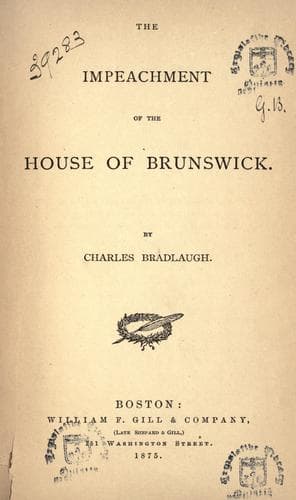
The Impeachment of the House of BrunswickBradlaugh, Charles
History
The Impeachment of the House of Brunswick
Bradlaugh, Charles
Great Britain -- History -- 1714-1837; Hanover, House of
Her Majesty's second son is Alfred Ernest, Duke of Edinburgh. His Royal
Highness, when serving on board the Galatea, had leave to go on shore
at Marseilles. Journeying to Paris, he overstayed his leave, refused to
return when summoned, and stayed there, so Paris journals said, till
his debts were thousands. Any other officer in the navy would have
been cashiered; his Royal Highness has since been promoted. The Duke of
Edinburgh visited our Colonies, and the nation voted about £3,500 for
presents made by the Prince. The presents the Prince received were,
of course, his own, and the vote enabled the Duke to do justice to the
generous sentiments of his family. The Colonists pretended at the time
that some of the presents were not paid for by the Duke of Edinburgh;
nay, they went so far as to allege that some of the Duke's debts had
to be discharged by the Colonist Reception Committee. Representing the
honor of England, his Royal Highness earned himself a fame and a name
by the associates he chose. In visiting India, a special sum of, we
believe, £10,000 was taken from the Indian revenues and handed to the
Duke, so that an English Prince might be liberal in his gifts to Indians
at their own cost. The Duke of Edinburgh has £25,000 a year. Five years
ago he borrowed £450 from the pay-chest of the Galatea. I have no means
of knowing whether it has since been paid back; all I can affirm is,
that the country made up the deficient sum in the pay-chest without a
word from any M. P. Had the borrower been a pay-sergeant, he would have
been sent to a District Military Prison; if a commissioned officer,
other than a Royal one, he would have been dismissed the service. The
difference between the Prince of Wales and the Duke of Edinburgh
is this: in the first case, the virtues of the Prince equal his
intelligence; in the second case, the intelligence of the Duke is more
developed than are his virtues.
In the case of Broadwood vs. the Duke of St. Albans, both the Royal
brothers were permitted to guard a pleasant incognito. The Judge who
allowed this concealment was soon afterwards created a Peer of the
Realm.
Public-domain text, read in full here on John Shaqi.
Reviews
Reviews
No reviews yet
Be the first to share your thoughts on this work.
Elsewhere in the archive
Join the Discussion
Join the discussion
Sign in to leave a comment or review.
Sign InorCreate an account