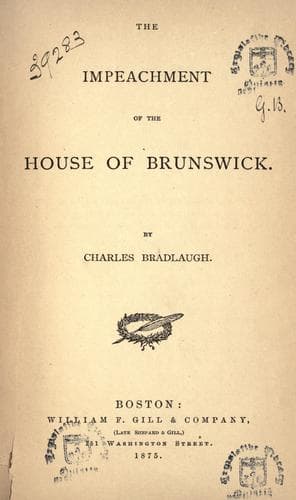
The Impeachment of the House of BrunswickBradlaugh, Charles
History
The Impeachment of the House of Brunswick
Bradlaugh, Charles
Great Britain -- History -- 1714-1837; Hanover, House of
Our army and navy, without reckoning the Indian Establishment, cost more
to-day, by about £9,000,000 a year, than when her Majesty ascended
the throne. Her Majesty's cousin, George William Frederick, Duke of
Cambridge, is Commander-in-Chief of the Army, and for this service
receives £4,432 per annum. His Royal Highness also receives the sum of
£12,000 in consequence of his being a cousin of the Queen. His Royal
Highness is also Field-Marshal, and Colonel of four distinct regiments,
for which he gets more than £5,000 annually. Naturally, in the Duke
is found embodied the whole military talent of the Royal Family. His
great-uncle, the Duke of Cumberland, carved "Klosterseven" on the
Brunswick monuments. Frederick Duke of York, the uncle of the Duke of
Cambridge, recalled from the field of battle, that he might wear in
peace at home the laurels he had won abroad, added "Clarke" and "Tonyn"
as names to vie with Cressy or Waterloo. The present Duke of Cambridge
was, when Prince George, stationed in Yorkshire, in the famous "plug
plot" times, and his valiancy then threatened most lustily what he would
do against the factory "turnouts," poor starved wretches clamoring for
bread. In the army, the normal schoolmasters can tell how this brave
Brunswicker rendered education difficult, and drove out, one by one,
many of the best teachers. Soldiers who think too much, make bad
machines. It was the father of the present Duke of Cambridge who
publicly expressed his disbelief, in 1844--5, of the failure of the
potato crop in Ireland, "because he had always found the potatoes at his
own table very good!"
For many years her Majesty's most constant attendant has been a
Scotsman, John Brown. This person so seldom leaves her Majesty that it
is said that some years since the Queen insisted on his presence when
diplomatic communications were made to her Majesty; and that, when
escorting the Queen to Camden House, on a visit to the ex-Emperor
Napoleon, Mr. Brown offered her his arm from the carriage to the door.
Afterwards, when an idiotic small boy--Armed with a broken pistol,
loaded with red flannel, and without gunpowder--made a sham attack on
her Majesty, Mr. Brown courageously rushed to the Queen's aid, and has
since received a medal to mark his valor.
For many years her Majesty has taken but little part in the show
ceremonials of State. Parliament is usually opened and closed by
commission--a robe on an empty throne, and a speech read by deputy,
satisfying the Sovereign's loyal subjects. It is, however, the fact that
in real State policy her interference has been most mischievous, and
this especially where it affected her Prusso-German relatives.' In the
case of Denmark attacked by Prussia and Austria, and in the case of
the Franco-Prussian War, English Court influences have most indecently
affected our foreign relations.
Public-domain text, read in full here on John Shaqi.
Reviews
Reviews
No reviews yet
Be the first to share your thoughts on this work.
Elsewhere in the archive
Join the Discussion
Join the discussion
Sign in to leave a comment or review.
Sign InorCreate an account