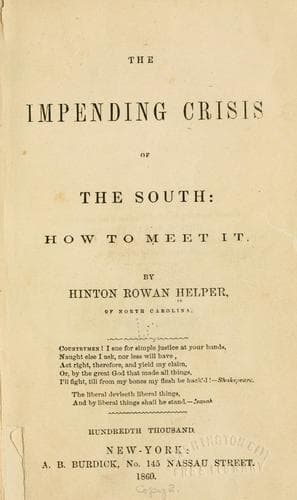
The Impending Crisis of the South: How to Meet ItHelper, Hinton Rowan
History
The Impending Crisis of the South: How to Meet It
Helper, Hinton Rowan
Slavery -- United States
A most unfortunate day was that for the Palmetto State, and indeed for the
whole South, when the course of trade was changed, and she found herself
the retailer of foreign and domestic goods, imported and vended by
wholesale merchants at the North. Philadelphia ladies no longer look to
the South for late fashions, and fine silks and satins; no Quaker dame now
wears drab apparel of Charleston importation. Like all other
_niggervilles_ in our disreputable part of the confederacy, the commercial
emporium of South Carolina is sick and impoverished; her silver cord has
been loosed; her golden bowl has been broken; and her unhappy people,
without proper or profitable employment, poor in pocket, and few in
number, go mourning or loafing about the streets. Her annual importations
are actually less now than they were a century ago, when South Carolina
was the second commercial province on the continent, Virginia being the
first.
In 1760, as we learn from Mr. Benton's "Thirty Years' View," the foreign
imports into Charleston were $2,662,000; in 1855, they amounted to only
$1,750,000! In 1854, the imports into Philadelphia, which, in foreign
trade, ranks at present but fourth among the commercial cities of the
union, were $21,963,021. In 1850, the products of manufactures, mining,
and the mechanic arts, in Pennsylvania, amounted to $155,044,910; the
products of the same in South Carolina, amounted to only $7,063,513.
As shown by the census report of 1850, which was prepared under the
superintendence of a native of South Carolina, who certainly will not be
suspected of injustice to his own section of the country, the Southern
states, the cash value of all the farms, farming implements, and machinery
in Pennsylvania, was $422,598,640; the value of the same in South
Carolina, in the same year, was only $86,518,038. From a compendium of the
same census, we learn that the value of all the real and personal property
in Pennsylvania, actual property, no slaves, amounted to $729,144,998; the
value of the same in South Carolina, including the estimated--we were
about to say fictitious--value of 384,925 negroes, amounted to only
$288,257,694. We have not been able to obtain the figures necessary to
show the exact value of the real and personal estate in Philadelphia, but
the amount is estimated to be not less than $300,000,000; and as, in 1850,
there were 408,762 free inhabitants in the single city of Philadelphia,
against 283,544 of the same class, in the whole state of South Carolina,
it is quite evident that the former is more powerful than the latter, and
far ahead of her in all the elements of genuine and permanent superiority.
In Pennsylvania, in 1850, the annual income of public schools amounted to
$1,348,249; the same in South Carolina, in the same year, amounted to only
$200,000; in the former state there were 393 libraries other than private,
in the latter only 26; in Pennsylvania 310 newspapers and periodicals were
Public-domain text, read in full here on John Shaqi.
Reviews
Reviews
No reviews yet
Be the first to share your thoughts on this work.
Join the Discussion
Join the discussion
Sign in to leave a comment or review.
Sign InorCreate an account