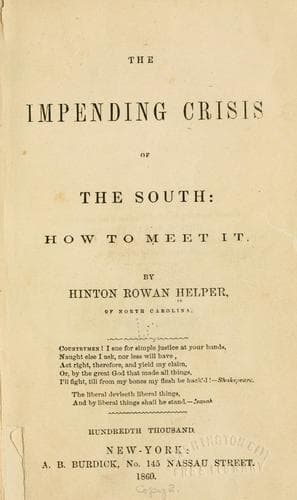
The Impending Crisis of the South: How to Meet ItHelper, Hinton Rowan
History
The Impending Crisis of the South: How to Meet It
Helper, Hinton Rowan
Slavery -- United States
For further testimony from this branch of the Christian system, if
desired, we refer the reader to the Rev. Dudley A. Tyng, the Rev. Evan M.
Johnson, and the Rev. J. McNamara,--all Broad Church Episcopalians, whose
magic eloquence and irresistible arguments bid fair, at an early day, to
win over to the paths of progressive freedom, truth, justice and humanity,
the greater number of their High and Low Church brethren.
BAPTIST TESTIMONY.
Concerning a certain text, the Rev. Mr. Brisbane, once a slaveholding
Baptist in South Carolina, says:--
"Paul was speaking of the law as having been made for men-stealers.
Where is the record of that law? It is in Exodus xxi. 16, and in
these words: 'He that stealeth a man, and selleth him, or if he be
found in his possession, he shall surely be put to death.' Here it
will be perceived that it was a crime to sell the man, for which the
seller must suffer death. But it was no less a crime to hold him as a
slave, for this also was punishable with death. A man may be
kidnapped out of slavery into freedom. There was no law against that.
And why? Because kidnapping a slave and placing him in a condition of
freedom, was only to restore him to his lost rights. But if the man
who takes him becomes a slaveholder, or a slave seller, then he is a
criminal, liable to the penalty of death, because he robs the man of
liberty. Perhaps some will say this law was only applicable to the
first holder of the slave, that is, the original kidnapper, but not
to his successors who might have purchased or inherited him. But what
is kidnapping? Suppose I propose to a neighbor to give him a certain
sum of money if he will steal a white child in Carolina and deliver
him to me. He steals him; I pay him the money upon his delivering the
child to me. Is it not my act as fully as his? Am I not also the
thief? But does it alter the case whether I agree before hand or not,
to pay him for the child? He steals him, and then sells him to me.
He is found by his parents in my hands. Will it avail me to say I
purchased him and paid my money for him? Will it not be asked, Do you
not know that a white person is not merchantable? And shall I not
have to pay the damage for detaining that child in my service as a
slave? Assuredly, not only in the eyes of the law, but in the
judgment of the whole community, I would be regarded a criminal. So
when one man steals another and offers him for sale, no one, in view
of the Divine law, can buy him, for the reason that the Divine law
forbids that man shall in the first place be made a merchantable
article. The inquiry must be, if I buy, I buy in violation of the
Divine law, and it will not do for me to plead that I bought him. I
have him in possession, and that is enough, God condemns me for it as
a man-stealer.
Public-domain text, read in full here on John Shaqi.
Reviews
Reviews
No reviews yet
Be the first to share your thoughts on this work.
Elsewhere in the archive
Join the Discussion
Join the discussion
Sign in to leave a comment or review.
Sign InorCreate an account