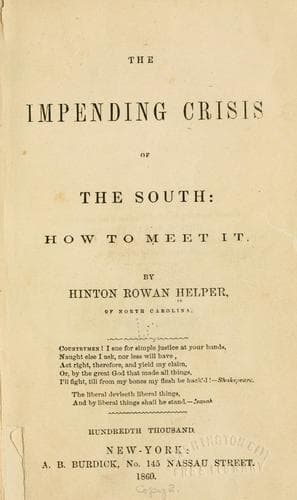
The Impending Crisis of the South: How to Meet ItHelper, Hinton Rowan
History
The Impending Crisis of the South: How to Meet It
Helper, Hinton Rowan
Slavery -- United States
My having him in possession is evidence against me,
and the Mosaic law says, if he be found in my hands, I must die. Now,
when Paul said the law was made for men-stealers, was it not also
saying the law was made for slaveholders? I am not intending to apply
this term in harsh spirit. But I am bound, as I fear God to speak
what I am satisfied is the true meaning of the apostle."
In his "Elements of Moral Science," the Rev. Francis Wayland, D.D., one of
the most erudite and distinguished Baptists now living, says:--
"Domestic slavery proceeds upon the principle that the master has a
right to control the actions, physical and intellectual, of the
slave, for his own, that is, the master's individual benefit; and, of
course, that the happiness of the master, when it comes in
competition with the happiness of the slave, extinguishes in the
latter the right to pursue it. It supposes, at best, that the
relation between master and slave, is not that which exists between
man and man, but is a modification, at least, of that which exists
between man and the brutes.
"Now, this manifestly supposes that the two classes of beings are
created with dissimilar rights: that the master posseses rights which
have never been conceded by the slave; and that the slave has no
rights at all over the means of happiness which God has given him,
whenever these means of happiness can be rendered available to the
service of his master. It supposes that the Creator intended one
human being to govern the physical, intellectual and moral actions of
as many other human beings as by purchase he can bring within his
physical power; and that one human being may thus acquire a right to
sacrifice the happiness of any number of other human beings, for the
purpose of promoting his own. Slavery thus violates the personal
liberty of man as a physical, intellectual, and moral being.
"It purports to give to the master a right to control the physical
labor of the slave, not for the sake of the happiness of the slave,
but for the sake of the happiness of the master. It subjects the
amount of labor, and the kind of labor, and the remuneration for
labor, entirely to the will of the one party, to the entire exclusion
of the will of the other party.
Public-domain text, read in full here on John Shaqi.
Reviews
Reviews
No reviews yet
Be the first to share your thoughts on this work.
Elsewhere in the archive
Join the Discussion
Join the discussion
Sign in to leave a comment or review.
Sign InorCreate an account