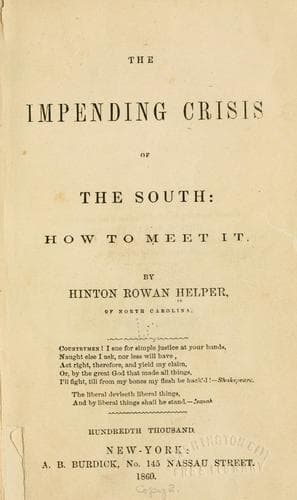
The Impending Crisis of the South: How to Meet ItHelper, Hinton Rowan
History
The Impending Crisis of the South: How to Meet It
Helper, Hinton Rowan
Slavery -- United States
It removes, as far as possible, from both parties, the disposition
and the motives to frugality. Neither the master learns frugality
from the necessity of labor, nor the slave from the benefits which it
confers. And here, while the one party wastes from ignorance of the
laws of acquisition, and the other because he can have no motive to
economy, capital must accumulate but slowly, if indeed it accumulate
at all.
No country, not of great fertility, can long sustain a large slave
population. Soils of more than ordinary fertility can not sustain it
long, after the richness of the soil has been exhausted. Hence,
slavery in this country is acknowledged to have impoverished many of
our most valuable districts; and, hence, it is continually migrating
from the older settlements, to those new and untilled regions, where
the accumulated manure of centuries of vegetation has formed a soil,
whose productiveness may, for a while, sustain a system at variance
with the laws of nature. Many of our free and of our slaveholding
States were peopled at about the same time. The slaveholding States
had every advantage, both in soil and climate, over their neighbors.
And yet the accumulation of capital has been greatly in favor of the
latter. If any one doubts whether this difference be owing to the use
of slave labor, let him ask himself what would have been the
condition of the slaveholding States, at this moment, if they had
been inhabited, from the beginning, by an industrious yeomanry; each
one holding his own land, and each one tilling it with the labor of
his own hands.
The moral precepts of the Bible are diametrically opposed to slavery.
They are, Thou shalt love thy _neighbor_ as _thyself_, and _all
things whatsoever_ ye would that men should do unto you, do ye even
so unto them.
The application of these precepts is universal. Our neighbor is
_every one whom we may benefit_. The obligation respects _all things
whatsoever_. The precept, then, manifestly, extends to _men, as men,
or men in every condition_; and if to all things whatsoever,
certainly to a thing so important as the right to personal liberty.
Again. By this precept, it is made our duty to cherish as tender and
delicate a respect for the right which the meanest individual
posseses over the means of happiness bestowed upon him by God, as we
cherish for our own right over our own means of happiness, or as we
desire any other individual to cherish for it. Now, were this precept
obeyed, it is manifest that slavery could not in fact exist for a
single instant. The principle of the precept is absolutely subversive
of the principle of slavery. That of the one is the entire equality
of right; that of the other, the entire absorption of the rights of
one in the rights of the other.
Public-domain text, read in full here on John Shaqi.
Reviews
Reviews
No reviews yet
Be the first to share your thoughts on this work.
Elsewhere in the archive
Join the Discussion
Join the discussion
Sign in to leave a comment or review.
Sign InorCreate an account