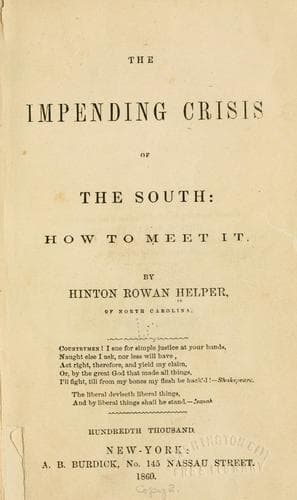
The Impending Crisis of the South: How to Meet ItHelper, Hinton Rowan
History
The Impending Crisis of the South: How to Meet It
Helper, Hinton Rowan
Slavery -- United States
"But if this right in the master over the slave be conceded there are
of course conceded all other rights necessary to insure its
possession. Hence, inasmuch as the slave can be held in this
condition only while he remains in the lowest state of mental
imbecility, it supposes the master to have the right to control his
intellectual development, just as far as may be necessary to secure
entire subjection. Thus, it supposes the slave to have no right to
use his intellect for the production of his own happiness; but, only
to use it in such manner as may conduce to his master's profit.
And, moreover, inasmuch as the acquisition of the knowledge of his
duty to God could not be freely made without the acquisition of other
knowledge, which might, if universally diffused, endanger the control
of the master, slavery supposes the master to have the right to
determine how much knowledge of his duty a slave shall obtain, the
manner in which he shall obtain it, and the manner in which he shall
discharge that duty after he shall have obtained a knowledge of it.
It thus subjects the duty of man to God entirely to the will of man;
and this for the sake of pecuniary profit. It renders the eternal
happiness of the one party subservient to the temporal happiness of
the other. And this principle is commonly carried into effect in
slaveholding countries.
If argument were necessary to show that such a system as this must be
at variance with the ordinance of God, it might be easily drawn from
the effects which it produces both upon _morals_ and _national
wealth_.
Its effects must be disastrous upon the _morals_ of both parties. By
presenting objects on whom passion may be satiated without resistance
and without redress, it cultivates in the master, pride, anger,
cruelty, selfishness and licentiousness. By accustoming the slave to
subject his moral principles to the will of another, it tends to
abolish in him all moral distinction; and thus fosters in him lying,
deceit, hypocrisy, dishonesty, and a willingness to yield himself up
to minister to the appetites of his master.
The effects of slavery on _national wealth_, may be easily seen from
the following considerations:--
Instead of imposing upon all the necessity of labor, it restricts the
number of laborers, that is of producers, within the smallest
possible limit, by rendering labor disgraceful.
It takes from the laborers the natural stimulus to labor, namely, the
desire in the individual of improving his condition; and substitutes,
in the place of it, that motive which is the least operative and the
least constant, namely, the fear of punishment without the
consciousness of moral delinquency.
Public-domain text, read in full here on John Shaqi.
Reviews
Reviews
No reviews yet
Be the first to share your thoughts on this work.
Elsewhere in the archive
Join the Discussion
Join the discussion
Sign in to leave a comment or review.
Sign InorCreate an account