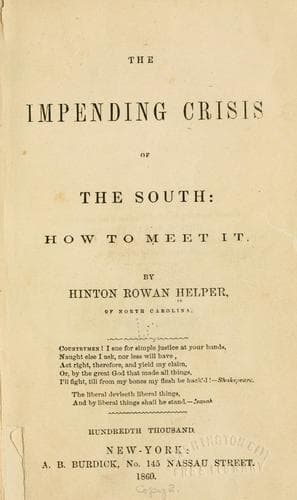
The Impending Crisis of the South: How to Meet ItHelper, Hinton Rowan
History
The Impending Crisis of the South: How to Meet It
Helper, Hinton Rowan
Slavery -- United States
Would the slaveholders of North Carolina lose anything by the abolition of
slavery? Let us see. According to their own estimate, their slaves are
worth, in round numbers, say, one hundred and twenty millions of dollars.
There are in the State twenty-eight thousand slaveholders, owning, it may
be safely assumed, an average of at least five hundred acres of land
each--fourteen millions of acres in all. This number of acres, multiplied
by thirty-three dollars and ninety-one cents, the difference in value
between free soil and slave soil, makes the enormous sum of four hundred
and seventy-four millions of dollars--showing that, by the abolition of
slavery, the slaveholders themselves would realize a net profit of not
less than three hundred and fifty-four millions of dollars!
Compensation to slaveholders for the negroes now in their possession! The
idea is preposterous. The suggestion is criminal. The demand is unjust,
wicked, monstrous, damnable. Shall we pat the bloodhounds of slavery for
the sake of doing them a favor? Shall we fee the curs of slavery in order
to make them rich at our expense? Shall we pay the whelps of slavery for
the privilege of converting them into decent, honest, upright men? No,
never! The non-slaveholders expect to gain, and will gain, something by
the abolition of slavery; but slaveholders themselves will, by far, be the
greater gainers; for, in proportion to population, they own much larger
and more fertile tracts of land, and will, as a matter of course, receive
the lion's share of the increase in the value of not only real estate, but
also of other genuine property, of which they are likewise the principal
owners. How ridiculously absurd, therefore, is the objection, that, if we
liberate the slaves, we ruin the masters! Not long since, a gentleman in
Baltimore, a native of Maryland, remarked in our presence that he was an
abolitionist because he felt that it was right and proper to be one;
"but," inquired he, "are there not, in some of the States, many widows and
orphans who would be left in destitute circumstances, if their negroes
were taken from them?" In answer to the question, we replied that slavery
had already reduced thousands and tens of thousands of non-slaveholding
widows and orphans to the lowest depths of poverty and ignorance, and that
we did not believe one slaveholding widow and three orphans were of more,
or even of as much consequence as five non-slaveholding widows and fifteen
orphans. "You are right," exclaimed the gentleman, "I had not viewed the
subject in that light before; I perceive you go in for the greatest good
to the greatest number." Emancipate the negroes, and the ex-slaveholding
widow would still retain her lands and tenements, which, in consequence of
being surrounded by the magic influences of liberty, would soon render her
far more wealthy and infinitely more respectable, than she could possibly
ever become while trafficking in human flesh.
Public-domain text, read in full here on John Shaqi.
Reviews
Reviews
No reviews yet
Be the first to share your thoughts on this work.
Elsewhere in the archive
Join the Discussion
Join the discussion
Sign in to leave a comment or review.
Sign InorCreate an account