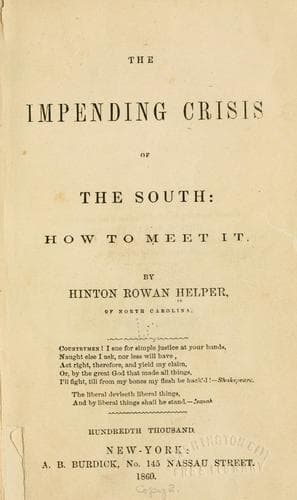
The Impending Crisis of the South: How to Meet ItHelper, Hinton Rowan
History
The Impending Crisis of the South: How to Meet It
Helper, Hinton Rowan
Slavery -- United States
"Be it enacted by the General Assembly of Maryland, That after the
passage of this act, it shall not be lawful for any citizen of this
State, knowingly to make, print or engrave, or aid in the making,
printing or engraving, within this State, any pictorial
representation, or to write or print, or to aid in the writing or
printing any pamphlet, newspaper, handbill or other paper of an
inflammatory character, and having a tendency to excite discontent
or stir up insurrection amongst the people of color of this State, or
of either of the other States or Territories of the United States, or
knowingly to carry or send, or to aid in the carrying or sending the
same for circulation amongst the inhabitants of either of the other
States or Territories of the United States, and any person so
offending shall be guilty of a felony, and shall on conviction be
sentenced to confinement in the penitentiary of this State, for a
period not less than ten nor more than twenty years, from the time of
sentence pronounced on such person."--_Act passed Dec. 1831. See 2nd
Dorsey, page 1218._
Now so long as slaveholders are clothed with the mantle of office, so long
will they continue to make laws, like the above, expressly calculated to
bring the non-slaveholding whites under a system of vassalage little less
onerous and debasing than that to which the negroes themselves are
accustomed. What wonder is it that there is no native literature in the
South? The South can never have a literature of her own until after
slavery shall have been abolished. Slaveholders are too lazy and ignorant
to write it, and the non-slaveholders--even the few whose minds are
cultivated at all--are not permitted even to make the attempt. Down with
the oligarchy! Ineligibility of slaveholders--never another vote to the
trafficker in human flesh!
LEGISLATIVE ACTS AGAINST SLAVERY.
In his Compendium of the Seventh Census, Mr. DeBow has compiled the
following useful and highly interesting facts:--
"The Continental Congress of 1774 resolved to discontinue the slave
trade, in which resolution they were anticipated by the Conventions
of Delegates of Virginia and North Carolina. In 1789 the Convention
to frame the federal Constitution, looked to the abolition of the
traffic in 1808. On the 2nd of March, 1807, Congress passed an act
against importations of Africans into the United States after January
1st, 1808. An act in Great Britain in 1807 also made the slave trade
unlawful. Denmark forbid the introduction of African slaves into her
colonies after 1804. The Congress of Vienna, in 1815, pronounced for
the abolition of the trade. France abolished it in 1817, and also
Spain, but the acts were to take effect after 1820. Portugal
abolished it in 1818.
Public-domain text, read in full here on John Shaqi.
Reviews
Reviews
No reviews yet
Be the first to share your thoughts on this work.
Elsewhere in the archive
Join the Discussion
Join the discussion
Sign in to leave a comment or review.
Sign InorCreate an account