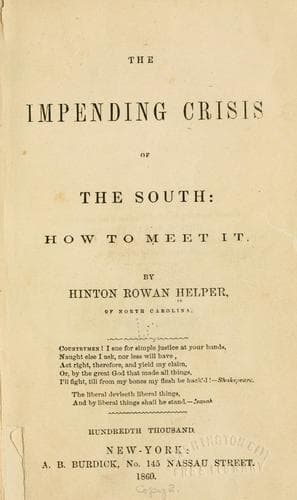
The Impending Crisis of the South: How to Meet ItHelper, Hinton Rowan
History
The Impending Crisis of the South: How to Meet It
Helper, Hinton Rowan
Slavery -- United States
"In Pennsylvania slavery was abolished in 1780. In New Jersey it was
provisionally abolished in 1784; all children born of a slave after
1804 are made free in 1820. In Massachusetts, it was declared after
the revolution, that slavery was virtually abolished by their
Constitution, (1780). In 1784 and 1797, Connecticut provided for a
gradual extinction of slavery. In Rhode Island, after 1784, no person
could be _born_ a slave. The Constitutions of Vermont and New
Hampshire, respectively, abolished slavery. In New York it was
provisionally abolished in 1799, twenty-eight years' ownership being
allowed in slaves born after that date, and in 1817 it was enacted
that slavery was not to exist after ten years, or 1827. The ordinance
of 1787 forbid slavery in the territory northwest of the Ohio."
Besides the instances enumerated above, slavery has been abolished in more
than forty different parts of the world within the last half century, and
with good results everywhere, except two or three West India islands,
where the negro population was greatly in excess of the whites; and even
in these, the evils, if any, that have followed, are not justly
attributable to abolition, but to the previous demoralization produced by
slavery.
In this connection we may very properly introduce the testimony of a West
India planter to the relative advantages of Free over Slave Labor. Listen
to Charles Pettyjohn, of Barbadoes, who, addressing himself to a citizen
of our own country, says:--
"In 1834, I came in possession of 257 slaves, under the laws of
England, which required the owner to feed, clothe, and furnish them
with medical attendance. With this number I cultivated my sugar
plantation until the Emancipation Act of August 1st, 1838, when they
all became free. I now hire a portion of those slaves, the best and
cheapest of course, as you hire men in the United States. The average
number which I employ is 100, with which I cultivate more land at a
cheaper rate, and make more produce than I did with 257 slaves. With
my slaves I made from 100 to 180 tons of sugar yearly. With 100 free
negroes I think I do badly if I do not annually produce 250 tons."
If, in the forty and more instances to which we have alluded, the
abolition of slavery had proved injurious in a majority of cases, the
attempt to abolish it elsewhere might, perhaps, be regarded as an
ill-advised effort; but, seeing that its abolition has worked well in at
least fourteen-fifteenths of all the cases on record, the fact becomes
obvious that it is our duty and our interest to continue to abolish it
until the whole world shall be freed, or until we shall begin to see more
evil than good result from our acts of emancipation.
THE TRUE FRIENDS OF THE SOUTH.
Public-domain text, read in full here on John Shaqi.
Reviews
Reviews
No reviews yet
Be the first to share your thoughts on this work.
Elsewhere in the archive
Join the Discussion
Join the discussion
Sign in to leave a comment or review.
Sign InorCreate an account