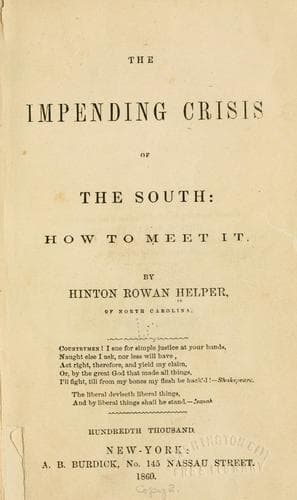
The Impending Crisis of the South: How to Meet ItHelper, Hinton Rowan
History
The Impending Crisis of the South: How to Meet It
Helper, Hinton Rowan
Slavery -- United States
Griswold's "Poets and Poetry of America" and Thomas Buchanan Read's
"Female Poets of America" furnish evidence, equally conclusive, of the
benumbing influence of slavery upon the intellect of a country. Of course,
these compilers say nothing about Slavery, and probably never thought of
it in connection with their respective works, but none the less
significant on that account is the testimony of the _facts_ which they
give. From the last edition of Griswold's compilation, (which contains the
names of none of our female writers, he having included them in a separate
volume) we find the names of one hundred and forty-one writers of verse:
of these _one_ was foreign-born, _seventeen_ natives of the slaveholding,
and _one hundred and twenty-three_ of the non-slaveholding States. Of our
female poets, whose nativity is given by Mr. Read, _eleven_ are natives of
the South; and _seventy-three_ of the North! These simple arithmetical
figures are God's eternal Scripture against the folly and madness of
Slavery, and need no aid of rhetoric to give emphasis to the startling
eloquence of their revelations.
But, after all, literature is not to be estimated by cubic feet or pounds
averdupois, nor measured by the bushel or the yardstick. Quality, rather
than quantity, is the true standard of estimation. The fact, however,
matters little for our present purpose; for the South, we are sorry to
say, is as much behind the North in the former as in the latter. We do not
forget the names of Gayarre, Benton, Simms, and other eminent citizens of
the Slave States, who have by their contributions to American letters
conferred honor upon themselves and upon our common country, when we
affirm, that those among our authors who enjoy a cosmopolitan reputation,
are, with a few honorable exceptions, natives of the Free North; and that
the names which most brilliantly illustrate our literature, in its every
department, are those which have grown into greatness under the nurturing
influence of free institutions. "Comparisons are odious," it is said; and
we will not, unnecessarily, render them more so, in the present instance,
by contrasting, name by name, the literary men of the South with the
literary men of the North. We do not depreciate the former, nor
overestimate the latter. But let us ask, whence come our geographers, our
astronomers, our chemists, our meteorologists, our ethnologists, and
others, who have made their names illustrious in the domain of the Natural
Sciences? Not from the Slave States, certainly. In the Literature of Law,
the South can furnish no name that can claim peership with those of Story
and of Kent; in History, none that tower up to the altitude of Bancroft,
Prescott, Hildreth, Motley and Washington Irving; in Theology, none that
can challenge favorable comparison with those of Edwards, Dwight,
Channing, Taylor, Bushnell, Tyler and Wayland in Fiction, none that take
rank with Cooper, and Mrs. Stowe; and but few that may do so with even the
Public-domain text, read in full here on John Shaqi.
Reviews
Reviews
No reviews yet
Be the first to share your thoughts on this work.
Elsewhere in the archive
Join the Discussion
Join the discussion
Sign in to leave a comment or review.
Sign InorCreate an account