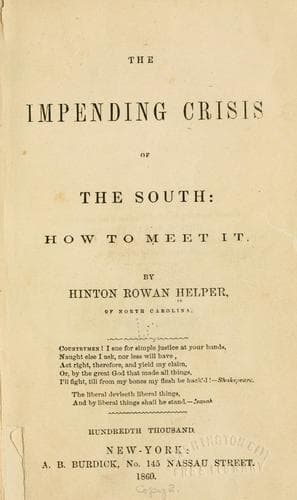
The Impending Crisis of the South: How to Meet ItHelper, Hinton Rowan
History
The Impending Crisis of the South: How to Meet It
Helper, Hinton Rowan
Slavery -- United States
second class novelists of the North;[9] in Poetry, none that can command
position with Bryant, Halleck, and Percival, with Whittier, Longfellow,
and Lowell, with Willis, Stoddard and Taylor, with Holmes, Saxe, and
Burleigh; and--we might add twenty other Northern names before we found
their Southern peer, with the exception of poor Poe, who, within a narrow
range of subjects, showed himself a poet of consummate art, and occupies a
sort of debatable ground between our first and second-class writers.
We might extend this comparison to our writers in every department of
letters, from the compiler of school-books to the author of the most
profound ethical treatise, and with precisely the same result. But we
forbear. The task is distasteful to our State pride, and would have been
entirely avoided had not a higher principle urged us to its performance.
It remains for us now to enquire,
WHAT HAS PRODUCED THIS LITERARY PAUPERISM OF THE SOUTH? One single word,
most pregnant in its terrible meanings, answers the question. That word
is--SLAVERY! But we have been so long accustomed to the ugly thing itself,
and have become so familiar with its no less ugly fruits, that the common
mind fails to apprehend the connection between the one, as cause, and the
other as effect; and it therefore becomes necessary to give a more
detailed answer to our interrogatory.
Obviously, then, the conditions requisite to a flourishing literature are
wanting at the South. These are--
I. Readers. The people of the South are not a reading people. Many of the
adult population never learned to read; still more, do not care to read.
We have been impressed, during a temporary sojourn in the North, with the
difference between the middle and laboring classes in the Free States, and
the same classes in the Slave States, in this respect. Passing along the
great routes of travel in the former, or taking our seat in the
comfortable cars that pass up and down the avenues of our great commercial
metropolis, we have not failed to contrast the employment of our
fellow-passengers with that which occupies the attention of the
corresponding classes on our various Southern routes of travel. In the one
case, a large proportion of the passengers seem intent upon mastering the
contents of the newspaper, or some recently published book. The merchant,
the mechanic, the artizan, the professional man, and even the common
laborer, going to or returning from their daily avocations, are busy with
their morning or evening paper, or engaged in an intelligent discussion of
some topic of public interest. This is their leisure hour, and it is given
to the acquisition of such information as may be of immediate or ultimate
use, or to the cultivation of a taste for elegant literature. In the other
case, newspapers and books seem generally ignored, and noisy discussions
of village and State politics, the tobacco and cotton crops, filibusterism
in Cuba, Nicaragua, or Sonora, the price of negroes generally, and
Public-domain text, read in full here on John Shaqi.
Reviews
Reviews
No reviews yet
Be the first to share your thoughts on this work.
Elsewhere in the archive
Join the Discussion
Join the discussion
Sign in to leave a comment or review.
Sign InorCreate an account