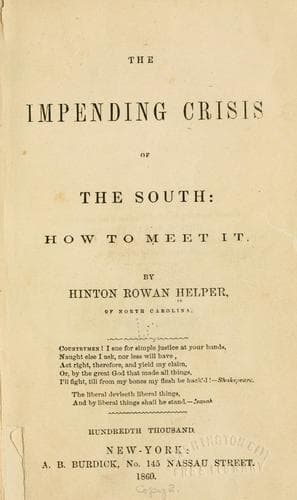
The Impending Crisis of the South: How to Meet ItHelper, Hinton Rowan
History
The Impending Crisis of the South: How to Meet It
Helper, Hinton Rowan
Slavery -- United States
II. Another thing essential to the creation of a literature is MENTAL
FREEDOM. How much of _that_ is to be found in the region of Slavery? We
will not say that there is _none_; but if it exists, it exists as the
outlawed antagonist of human chattelhood. He who believes that the
despotism of the accursed institution expends its malignant forces upon
the _slave_, leaving intact the white and (so called) free population, is
the victim of a most monstrous delusion. One end of the yoke that bows the
African to the dust, presses heavily upon the neck of his Anglo-Saxon
master. The entire mind of the South either stultifies itself into
acquiescence with Slavery, succumbs to its authority, or chafes in
indignant protest against its monstrous pretensions and outrageous
usurpations. A free press is an institution almost unknown at the South.
Free speech is considered as treason against slavery: and when people dare
neither speak nor print their thoughts, free thought itself is well nigh
extinguished. All that can be said in _defence_ of human bondage, may be
spoken freely; but question either its morality or its policy, and the
terrors of lynch law are at once invoked to put down the pestilent heresy.
The legislation of the Slave States for the suppression of the freedom of
speech and the press, is disgraceful and cowardly to the last degree, and
can find its parallel only in the meanest and bloodiest despotisms of the
Old World. No institution that could bear the light would thus sneakingly
seek to burrow itself in utter darkness. Look, too, at the mobbings,
lynchings, robberies, social and political proscriptions, and all manner
of nameless outrages, to which men in the South have been subjected,
simply upon the suspicion that they were the enemies of Slavery. We could
fill page after page of this volume with the record of such atrocities.
But a simple reference to them is enough. Our countrymen have not yet
forgotten why John C. Underwood was, but a few months since, banished from
his home in Virginia, and the accomplished Hedreck driven from his College
professorship in North Carolina. They believed Slavery inimical to the
best interest of the South, and for daring to give expression to this
belief in moderate yet manly language, they were ostracised by the
despotic Slave Power, and compelled to seek a refuge from its vengeance in
States where the principles of freedom are better understood. Pending the
last Presidential election, there were thousands, nay, tens of thousands
of voters in the Slave States, who desired to give their suffrages for the
Republican nominee, John C. Fremont, himself a Southron, but a
non-slaveholder. The Constitution of the United States guaranteed to these
men an expression of their preference at the ballot-box. But were they
permitted such an expression? Not at all. They were denounced, threatened,
overawed, by the Slave Power--and it is not too much to say that there was
Public-domain text, read in full here on John Shaqi.
Reviews
Reviews
No reviews yet
Be the first to share your thoughts on this work.
Elsewhere in the archive
Join the Discussion
Join the discussion
Sign in to leave a comment or review.
Sign InorCreate an account