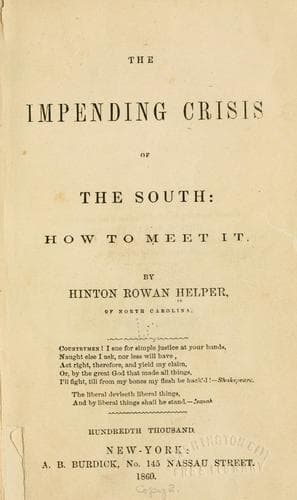
The Impending Crisis of the South: How to Meet ItHelper, Hinton Rowan
History
The Impending Crisis of the South: How to Meet It
Helper, Hinton Rowan
Slavery -- United States
really no _Constitutional election_,--that is, no such free expression of
political preferences as the Constitution aims to secure--in a majority of
the Slave States.
From a multiplicity of facts like these, the inference is unavoidable,
that Slavery tolerates no freedom of the press--no freedom of speech--no
freedom of opinion. To expect that a whole-souled, manly literature can
flourish under such conditions, is as absurd as it would be to look for
health amid the pestilential vapors of a dungeon, or for the continuance
of animal life without the aid of oxygen.
III. Mental activity--force--enterprise--are requisite to the creation of
literature. Slavery tends to sluggishness--imbecility--inertia. Where free
thought is treason, the masses will not long take the trouble of thinking
at all. Desuetude begets incompetence--the _dare-not_ soon becomes the
_cannot_. The mind thus enslaved, necessarily loses its interest in the
processes of other minds; and its tendency is to sink down into absolute
stolidity or sottishness. Our remarks find melancholy confirmation in the
abject servilism in which multitudes of the non-slaveholding whites of the
South are involved. In them, ambition, pride, self-respect, hope, seem
alike extinct. Their slaveholding fellows are, in some respects, in a
still more unhappy condition--helpless, nerveless, ignorant, selfish; yet
vain-glorious, self-sufficient and brutal. Are these the chosen architects
who are expected to build up "a purely Southern literature?"
The truth is, slavery destroys, or vitiates, or pollutes, whatever it
touches. No interest of society escapes the influence of its clinging
curse. It makes Southern religion a stench in the nostrils of
Christendom--it makes Southern politics a libel upon all the principles of
Republicanism--it makes Southern literature a travesty upon the honorable
profession of letters. Than the better class of Southern authors
themselves, none will feel more keenly the truth of our remarks. They
write books, but can find for them neither publishers nor remunerative
sales at the South. The executors of Calhoun seek, for his works, a
Northern publisher. Benton writes history and prepares voluminous
compilations, which are given to the world through a Northern publisher.
Simms writes novels and poems, and they are scattered abroad from the
presses of a Northern publisher. Eighty per cent. of all the copies sold
are probably bought by Northern readers.
Public-domain text, read in full here on John Shaqi.
Reviews
Reviews
No reviews yet
Be the first to share your thoughts on this work.
Elsewhere in the archive
Join the Discussion
Join the discussion
Sign in to leave a comment or review.
Sign InorCreate an account