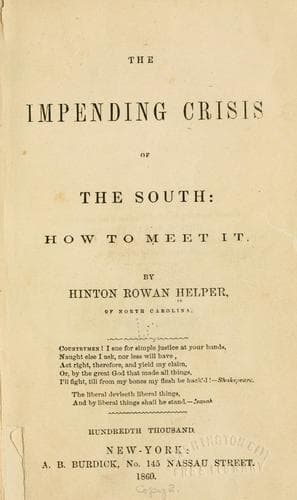
The Impending Crisis of the South: How to Meet ItHelper, Hinton Rowan
History
The Impending Crisis of the South: How to Meet It
Helper, Hinton Rowan
Slavery -- United States
"I know not when I have been more humiliated, as a North Carolina farmer,
than when, a few weeks ago, at a railroad depot at the very doors of our
State capital, I saw wagons drawn by Kentucky mules, loading with
Northern hay, for the supply not only of the town, but to be taken to the
country. Such a sight at the capital of a State whose population is almost
exclusively devoted to agriculture, is a most humiliating exhibition. Let
us cease to use every thing, as far as it is practicable, that is not the
product of our own soil and workshops--not an axe, or a broom, or bucket,
from Connecticut. By every consideration of self-preservation, we are
called to make better efforts to expel the Northern grocer from the State
with his butter, and the Ohio and Kentucky horse, mule and hog driver,
from our county at least. It is a reproach on us as farmers, and no little
deduction from our wealth, that we suffer the population of our towns and
villages to supply themselves with butter from another Orange County in
New-York."
We have promised to prove that the hay crop of the free states is worth
considerably more than all the cotton, tobacco, rice, hay and hemp
produced in the fifteen slave States. The compilers of the last census, as
we learn from Prof. De Bow, the able and courteous superintendent, in
making up the hay-tables, allowed two thousand two hundred and forty
pounds to the ton. The price per ton at which we should estimate its value
has puzzled us to some extent. Dealers in the article in Baltimore think
it will average twenty-five dollars, in their market. Four or five months
ago they sold it at thirty dollars per ton. At the very time we write,
though there is less activity in the article than usual, we learn, from an
examination of sundry prices-current and commercial journals, that hay is
selling in Savannah at $33 per ton; in Mobile and New Orleans at $26; in
Charleston at $25; in Louisville at $24; and in Cincinnati at $23. The
average of these prices is _twenty-six dollars sixteen and two-third
cents_; and we suppose it would be fair to employ the figures which would
indicate this amount, the net value of a single ton, in calculating the
total market value of the entire crop. Were we to do this--and, with the
foregoing facts in view, we submit to intelligent men whether we would not
be justifiable in doing it,--the hay crop of the free states, 12,690,982
tons, in 1850, would amount in valuation to the enormous sum of
$331,081,695--more than four times the value of all the cotton produced in
the United States during the same period!
Public-domain text, read in full here on John Shaqi.
Reviews
Reviews
No reviews yet
Be the first to share your thoughts on this work.
Join the Discussion
Join the discussion
Sign in to leave a comment or review.
Sign InorCreate an account