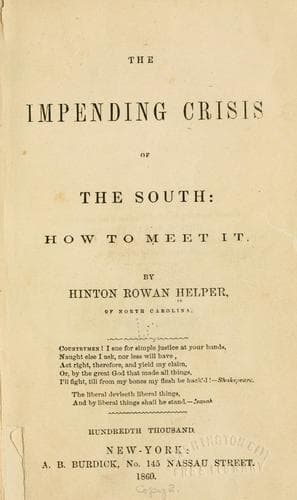
The Impending Crisis of the South: How to Meet ItHelper, Hinton Rowan
History
The Impending Crisis of the South: How to Meet It
Helper, Hinton Rowan
Slavery -- United States
We would fain avoid all personalities and uncomplimentary allusions to the
dead, but when men, from love of lucre, from mere selfish motives, or from
sheer turpitude of heart, inflict great injuries and outrages on the
public, their villainy ought to be exposed, so that others may be deterred
from following in their footsteps. As a general rule, man's moral nature
is, we believe, so strong that it invariably prompts him to eschew vice
and practice virtue--in other words, to do right; but this rule, like all
others, has its exceptions, as might be most strikingly illustrated in the
character of ---- ----, and some half-dozen or more of his pro-slavery
coadjutors. From whose hands did this man receive fifty thousand
dollars--improperly, if not illegally, taken from the public funds in
Washington? When did he receive it?--and for what purpose?--and who was
the arch-demagogue through whose agency the transfer was made? He was an
oligarchical member of the Cabinet under Mr. Polk's administration in
1845,--and the money was _used_,--and who can doubt _intended_?--for the
express purpose of establishing another negro-driving journal to support
the tottering fortunes of slavery. From the second volume of a valuable
political work, "by a Senator of thirty years," we make the following
pertinent extract:--
"The _Globe_ was sold, and was paid for, and how? becomes a question of
public concern to answer; for it was paid for out of public money--those
same $50,000 which were removed to the village bank in the interior of
Pennsylvania by a Treasury order on the fourth of November, 1844. Three
annual installments made the payment, and the Treasury did not reclaim the
money for these three years; and, though traveling through tortuous
channels, the sharpsighted Mr. Rives traced the money back to its starting
point from that deposit. Besides, Mr. Cameron, who had control of the
village bank, admitted before a committee of Congress, that he had
furnished money for the payments--an admission which the obliging
Committee, on request, left out of their report. Mr. Robert J. Walker was
Secretary of the Treasury during these three years, and the conviction was
absolute, among the close observers of the course of things, that he was
the prime contriver and zealous manager of the arrangements which
displaced Mr. Blair and installed Mr. Ritchie."
Public-domain text, read in full here on John Shaqi.
Reviews
Reviews
No reviews yet
Be the first to share your thoughts on this work.
Elsewhere in the archive
Join the Discussion
Join the discussion
Sign in to leave a comment or review.
Sign InorCreate an account