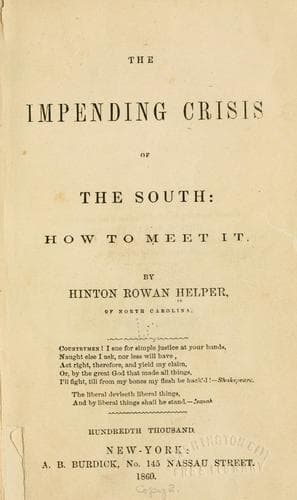
The Impending Crisis of the South: How to Meet ItHelper, Hinton Rowan
History
The Impending Crisis of the South: How to Meet It
Helper, Hinton Rowan
Slavery -- United States
Thus, if we are to believe Mr. Benton, in his "Thirty Year's View," and we
are disposed to regard him as good authority, the Washington _Union_ was
brought into existence under the peculiar auspices of the ostensible
editor of the Richmond _Enquirer_; and the two papers, fathered by the
same individual, have gone hand in hand for the last dozen or thirteen
years, the shameless advocates and defenders of human bondage. To suppose
that either has been sustained by fairer means than it was commenced with,
would be wasting imagination on a great improbability. Both have uniformly
and pertinaciously opposed every laudable enterprise that the white
non-slaveholder has projected; indeed, so unmitigated has been their
hostility to all manual pursuits in which their stupid and vulgar slaves
can not be employed to advantage--and if there is any occupation under the
sun in which they can be employed to good advantage, we know not what it
is--that it is an extremely difficult matter to find a respectable
merchant, mechanic, manufacturer, or business man of any calling whatever,
within the bounds of their circulation.
We have been credibly informed by a gentleman from Powhattan county, in
Virginia, that in the year 1836 or '37, or about that time, the Hon.
Abbott Lawrence, of Boston, backed by his brother Amos and other
millionaires of New England, went down to Richmond with the sole view of
reconnoitering the manufacturing facilities of that place--fully
determined, if pleased with the water-power, to erect a large number of
cotton-mills and machine-shops. He had been in the capital of Virginia
only a day or two before he discovered, much to his gratification, that
nature had shaped everything to his liking; and as he was a business man
who transacted business in a business-like manner, he lost no time in
making preliminary arrangements for the consummation of his noble purpose.
His mission was one of peace and promise; others were to share the
benefits of his laudable and concerted scheme; thousands of poor boys and
girls in Virginia, instead of growing up in extreme poverty and ignorance,
or of having to emigrate to the free States of the West, were to have
avenues of profitable employment opened to them at home; thus they would
be enabled to earn an honest and reputable living, to establish and
sustain free schools, free libraries, free lectures, and free presses, to
become useful and exemplary members of society, and to die fit candidates
for heaven. The magnanimous New Englander was in ecstasies with the
prospect that opened before him. Individually, so far as mere money was
concerned, he was perfectly independent; his industry and economy in early
life had secured to him the ownership and control of an ample fortune.
With the aid of eleven other men, each equal to himself, he could have
bought the whole city of Richmond--negroes and all--though it is not to be
presumed that he would have disgraced his name by becoming a trader in
human flesh.
Public-domain text, read in full here on John Shaqi.
Reviews
Reviews
No reviews yet
Be the first to share your thoughts on this work.
Elsewhere in the archive
Join the Discussion
Join the discussion
Sign in to leave a comment or review.
Sign InorCreate an account