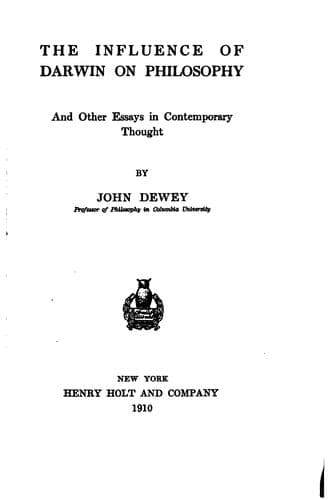
The Influence of Darwin on Philosophy, and other essays in contemporary thought — John Shaqi
The Influence of Darwin on Philosophy, and other essays in contemporary thoughtDewey, John
Philosophy
The Influence of Darwin on Philosophy, and other essays in contemporary thought
Dewey, John
Evolution; Philosophy; Pragmatism
THE INFLUENCE OF
DARWIN ON PHILOSOPHY
And Other Essays in Contemporary
Thought
BY
JOHN DEWEY
_Professor of Philosophy in Columbia University_
[Illustration]
NEW YORK
HENRY HOLT AND COMPANY
COPYRIGHT, 1910,
BY
HENRY HOLT AND COMPANY
_Published April, 1910_
PREFACE
An elaborate preface to a philosophic work usually impresses one as a
last desperate effort on the part of its author to convey what he feels
he has not quite managed to say in the body of his book. Nevertheless,
a collection of essays on various topics written during a series
of years may perhaps find room for an independent word to indicate
the kind of unity they seem, to their writer, to possess. Probably
every one acquainted with present philosophic thought--found, with
some notable exceptions, in periodicals rather than in books--would
term it a philosophy of transition and reconstruction. Its various
representatives agree in what they oppose--the orthodox British
empiricism of two generations ago and the orthodox Neo-Kantian idealism
of the last generation--rather than in what they proffer.
The essays of this volume belong, I suppose, to what has come
to be known (since the earlier of them were written) as the
pragmatic phase of the newer movement. Now a recent German critic
has described pragmatism as, “Epistemologically, nominalism;
psychologically, voluntarism; cosmologically, energism; metaphysically,
agnosticism; ethically, meliorism on the basis of the Bentham-Mill
utilitarianism.”[1] It may be that pragmatism will turn out to be all
of this formidable array; but even should it, the one who thus defines
it has hardly come within earshot of it. For whatever else pragmatism
is or is not, the pragmatic spirit is primarily a revolt against that
habit of mind which disposes of anything whatever--even so humble an
affair as a new method in Philosophy--by tucking it away, after this
fashion, in the pigeon holes of a filing cabinet. There are other vital
phases of contemporary transition and revision; there are, for example,
a new realism and naturalistic idealism. When I recall that I find
myself more interested (even though their representatives might decline
to reciprocate) in such phases than in the systems marked by the labels
of our German critic, I am confirmed in a belief that after all it is
better to view pragmatism quite vaguely as part and parcel of a general
movement of intellectual reconstruction. For otherwise we seem to have
no recourse save to define pragmatism--as does our German author--in
terms of the very past systems against which it is a reaction; or, in
escaping that alternative, to regard it as a fixed rival system making
like claim to completeness and finality. And if, as I believe, one of
the marked traits of the pragmatic movement is just the surrender of
every such claim, how have we furthered our understanding of pragmatism?
Public-domain text, read in full here on John Shaqi.
Reviews
Reviews
No reviews yet
Be the first to share your thoughts on this work.
Join the Discussion
Join the discussion
Sign in to leave a comment or review.
Sign InorCreate an account