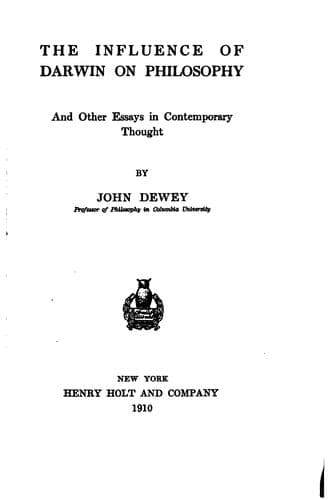
The Influence of Darwin on Philosophy, and other essays in contemporary thoughtDewey, John
Philosophy
The Influence of Darwin on Philosophy, and other essays in contemporary thought
Dewey, John
Evolution; Philosophy; Pragmatism
The dualism between faith authoritatively supported as the principle of
this life, and knowledge supernaturally realized as the principle of
the next, was transmuted into the dualism between intelligence now and
here occupied with natural things, and the affections and accompanying
beliefs, now and here realizing spiritual worths. For a time this
dualism operated as a convenient division of labor. Intelligence, freed
from responsibility for and preoccupation with supernatural truths,
could occupy itself the more fully and efficiently with the world
that now is; while the affections, charged with the values evoked in
the medieval discipline, entered into the present enjoyment of the
delectations previously reserved for the saints. Directness took the
place of systematic intermediation; the present of the future; the
individual’s emotional consciousness of the supernatural institution.
Between science and faith, thus conceived, a bargain was struck.
Hands off; each to his own, was the compact; the natural world to
intelligence, the moral, the spiritual world to belief. This (natural)
world for knowledge; that (supernatural) world for belief. Thus the
antithesis, unexpressed, ignored, _within experience_, between belief
and knowledge, between the purely objective values of thought and the
personal values of passion and volition, was more fundamental, more
determining, than the opposition, explicit and harassing, _within
knowledge_, between subject and object, mind and matter.
This latent antagonism worked out into the open. In scientific detail,
knowledge encroached upon the historic traditions and opinions with
which the moral and religious life had identified itself. It made
history to be as natural, as much its spoil, as physical nature. It
turned itself upon man, and proceeded remorselessly to account for
his emotions, his volitions, his opinions. Knowledge, in its general
theory, as philosophy, went the same way. It was pre-committed to
the old notion: the absolutely real is the object of _knowledge_,
and hence is something universal and impersonal. So, whether by the
road of sensationalism or rationalism, by the path of mechanicalism
or objective idealism, it came about that concrete selves, specific
feeling and willing beings, were relegated with the beliefs in which
they declare themselves to the “phenomenal.”
III
So much for the situation against which some contemporary tendencies
are a deliberate protest.
Public-domain text, read in full here on John Shaqi.
Reviews
Reviews
No reviews yet
Be the first to share your thoughts on this work.
Elsewhere in the archive
Join the Discussion
Join the discussion
Sign in to leave a comment or review.
Sign InorCreate an account