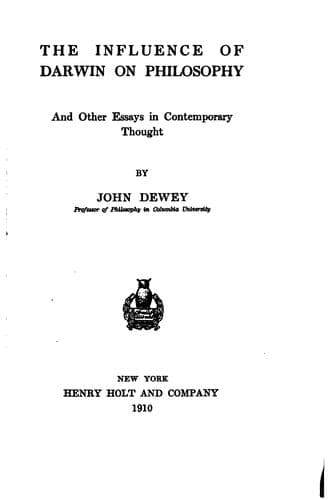
The Influence of Darwin on Philosophy, and other essays in contemporary thoughtDewey, John
Philosophy
The Influence of Darwin on Philosophy, and other essays in contemporary thought
Dewey, John
Evolution; Philosophy; Pragmatism
What of the positive conditions that give us not mere protest, like
the unreasoning revolt of heart against head found at all epochs, but
something articulate and constructive? The field is only too large,
and I shall limit myself to the evolution of the knowledge standpoint
itself. I shall suggest, first, that the progress of intelligence
directed upon natural materials has evolved a procedure of knowledge
that renders untenable the inherited conception of knowledge; and,
secondly, that this result is reinforced by the specific results of
some of the special sciences.
1. First, then, the very use of the knowledge standpoint, the very
expression of the knowledge preoccupation, has produced methods and
tests that, when formulated, intimate a radically different conception
of knowledge, and of its relation to existence and belief, than the
orthodox one.
The one thing that stands out is that thinking is inquiry, and that
knowledge as science is the outcome of systematically directed inquiry.
For a time it was natural enough that inquiry should be interpreted
in the old sense, as just change of subjective attitudes and opinions
to make them square up with a “reality” that is already there in
ready-made, fixed, and finished form. The rationalist had one notion
of the reality, _i.e._, that it was of the nature of laws, genera,
or an ordered system, and so thought of concepts, axioms, etc.,
as the indicated modes of representation. The empiricist, holding
reality to be a lot of little discrete particular lumps, thought of
disjointed sensations as its appropriate counterpart. But both alike
were thorough conformists. If “reality” is already and completely
given, and if knowledge is just submissive acceptance, then, of
course, inquiry is only a subjective change in the human “mind” or in
“consciousness,”--these being subjective and “unreal.”
Public-domain text, read in full here on John Shaqi.
Reviews
Reviews
No reviews yet
Be the first to share your thoughts on this work.
Elsewhere in the archive
Join the Discussion
Join the discussion
Sign in to leave a comment or review.
Sign InorCreate an account